28. Motor Control Fundamentals in Industrial Automation (28 of 41)
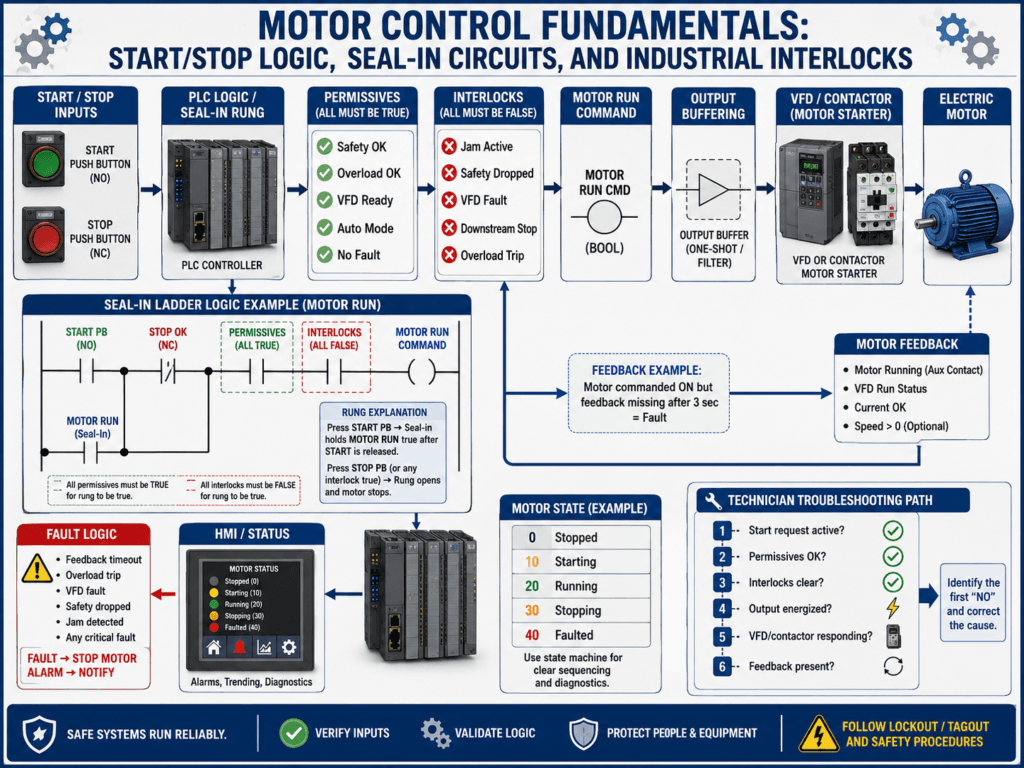
Almost every industrial machine depends on motors.
Conveyors, pumps, fans, mixers, compressors, fillers, wrappers — all rely on motor control logic.
That means:
If you understand motor control, you understand a large portion of real industrial PLC systems.
1. Basic Motor Start/Stop Concept
At the simplest level, a motor needs two actions:
START → Motor runs
STOP  → Motor stops
But in real systems, it is never that simple.
Because we must also consider:
Safety conditions
Overload protection
VFD readiness
Feedback confirmation
Interlocks
Permissives
Fault conditions
Manual/Auto modes
2. Basic Seal-In (Latch) Logic
The most important concept in motor control is the seal-in circuit.
Standard ladder concept:
Start PB      Stop OK      Motor Run
---| |----------| |-----------( )---
        |                   |
        |---- Motor Run ----|
How it works
Press Start → Motor turns ON
Motor Run bit seals itself ON
Release Start → Motor stays ON
Press Stop → Motor turns OFF
This is the foundation of almost every motor control system.
3. PLC Version of Motor Seal-In
In PLC logic (modern style):
Start_Request
AND Stop_OK
AND Permissive_OK
AND NOT Fault_Active
= Motor_Run_Command
Then:
Motor_Run_Command → Output Motor Starter4. Why Seal-In Is Important
Without seal-in logic:
Motor only runs while button is pressedWith seal-in:
Motor continues running until Stop or FaultThis is critical for industrial machines.
5. Real Industrial Motor Control Structure
A professional motor control logic always includes:
Inputs
Start PB
Stop PB
Overload
Motor feedback
VFD ready
Safety OK
Internal logic
Start Request
Permissive OK
Interlocks
Faults
Run Command
Output
Motor Contactor OR VFD Run Input6. Permissives in Motor Control
A motor should only start if conditions are safe.
Example:
Safety_OK
AND Overload_OK
AND VFD_Ready
AND No_Fault
AND Mode_Auto
If ANY is false:
Motor cannot start7. Interlocks in Motor Control
Interlocks stop the motor while running.
Examples:
Jam detected
Overload trip
Safety drop
Downstream stop
VFD fault
Logic:
If interlock becomes active → motor stops immediately8. Feedback Confirmation (Very Important)
Feedback tells us if the motor actually started.
Example:
Motor_Run_Command = ON
Motor_Feedback = OFF after 3 sec
→ FAULT
This is one of the most common real-world faults.
9. Motor Fault Logic Example
IF Motor commanded ON
AND feedback does NOT come ON
WITHIN 3 seconds
THEN latch Motor_Fault
Possible causes:
Contactor failure
VFD not starting
Overload tripped
Wiring issue
Bad feedback contact
10. Motor States (Mini State Machine)
Even motors often use states:
0 = Stopped
10 = Starting
20 = Running
30 = Stopping
40 = Faulted
Example:
Start request → 10 Starting
Feedback OK → 20 Running
Stop request → 30 Stopping
Fault → 40 Faulted
11. VFD Motor Control vs Contactor
Contactor Control
PLC → Output → Coil → Motor ON/OFFSimple ON/OFF control.
VFD Control
PLC → Run Command → VFD → MotorAdditional signals:
Speed reference
Fault status
Ready status
At speed feedback
VFD systems are more complex but more flexible.
12. Motor Control Troubleshooting Path
When a motor does not start:
1. Is Start request active?
2. Are permissives TRUE?
3. Are interlocks FALSE?
4. Is fault active?
5. Is output energizing?
6. Is VFD or contactor receiving signal?
7. Is feedback responding?
13. Motor Starts Then Stops
Common causes:
Feedback missing
Interlock triggered
Overload trip
Safety drop
VFD fault
Jam condition
Timer timeout
14. Common Mistakes in Motor Logic
No seal-in logic
No feedback monitoring
No fault latch
Using raw inputs directly
Duplicate output control
Missing permissives
No interlock separation
15. Best Practice Motor Structure
Input Buffering
Start Request
Stop Logic
Permissives
Interlocks
Command Logic
Feedback Check
Fault Logic
Output Buffering
HMI Status
16. Technician Checklist
Is Start request active?
Are permissives OK?
Any interlock active?
Any fault latched?
Is output commanded?
Is field device responding?
Is feedback present?
Is timing correct?
Is state correct?
Final Thoughts
Motor control is the foundation of industrial automation.
Once you understand:
- Seal-in logic
- Permissives
- Interlocks
- Feedback
- Fault detection
You can troubleshoot most machines in the field.
A motor is not just ON or OFF — it is a controlled system with conditions, feedback, and protection.