Can a PLC Course Really Make You a PLC Programmer?
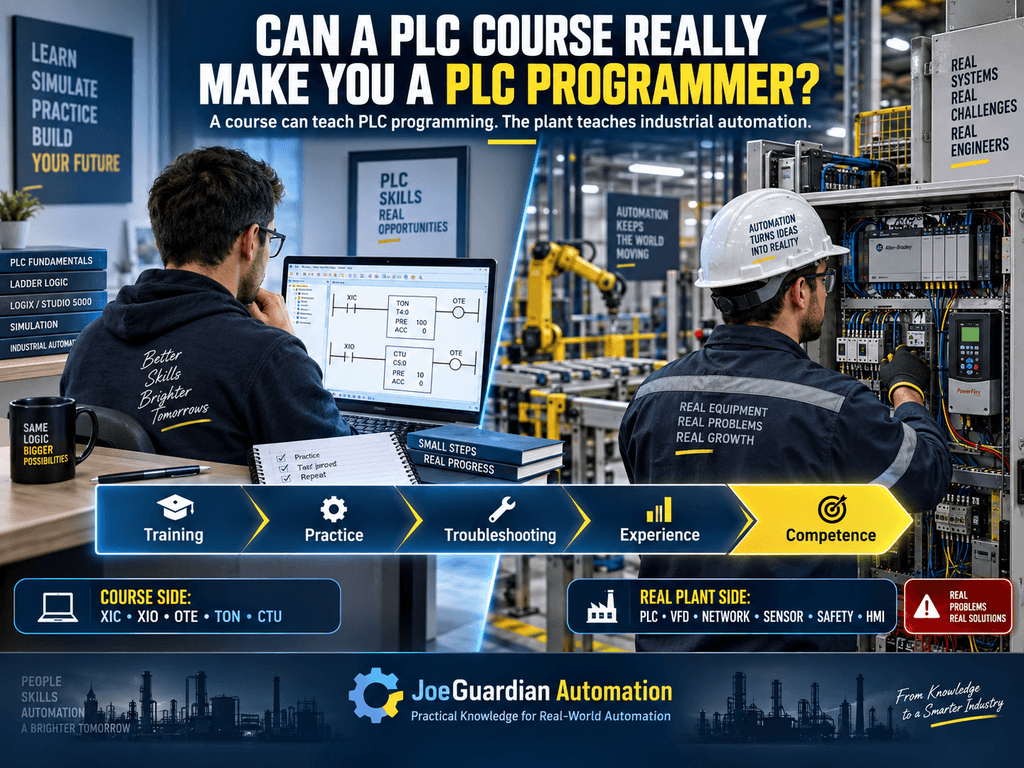
There is a message becoming increasingly common in industrial automation:
Take a PLC course, learn ladder logic, become a PLC programmer, and start making great money.
There is some truth inside that message.
PLC programming is absolutely learnable.
Online courses can be extremely valuable.
Simulation software can accelerate learning.
And someone who studies seriously can make significant progress without having years of previous experience.
But there is also a dangerous misunderstanding hidden inside the marketing:
Completing a PLC course is not the same as being ready to design, modify, troubleshoot, and maintain real industrial automation systems.
That distinction matters.
Not because we want to discourage people from entering automation.
Quite the opposite.
People entering this field deserve to understand what they are actually signing up for.
Industrial automation is rewarding.
It is challenging.
And it is much deeper than memorizing a collection of PLC instructions.
1. A PLC Course Can Give You the Foundation
A good PLC fundamentals course can teach you important concepts such as:
XIC
XIO
OTE
OTL / OTU
Timers
Counters
MOV
Comparisons
One-Shots
Seal-In Logic
Basic Sequencing
Analog Scaling
These are essential tools.
You need them.
But learning the tools is not the same as mastering the trade.
Knowing what a TON instruction does is one thing.
Knowing when to use it, why it belongs there, what its preset should be, what happens if it expires, and how the machine should recover afterward is something else entirely.
That second level requires judgment.
And judgment takes time to develop.
2. Knowing Ladder Logic Is Not the Same as Knowing Automation
A PLC does not exist by itself.
A real machine may include:
PLC
│
├── Electrical Control
├── Contactors and Motor Starters
├── VFDs
├── Servo Drives
├── Sensors
├── Instrumentation
├── Pneumatics
├── Hydraulics
├── Safety Systems
├── Industrial Networks
├── Remote I/O
├── HMI
├── SCADA
├── Robots
├── OPC
├── Databases
├── Virtual Machines
└── Production Systems
Then add the process itself.
What is the machine supposed to do?
When should equipment start?
When should it stop?
What conditions must be present?
What should happen when something fails?
Now PLC programming becomes only one part of a much larger control system.
3. There Is a Big Difference Between “It Works” and “It Is Industrial”
A beginner can write:
Start_PB
----| |----------------( Motor )
and successfully make a motor output energize.
That is progress.
But an industrial program may need to consider:
Start Request
      ↓
Correct Mode
      ↓
Permissives
      ↓
Interlocks
      ↓
VFD Ready
      ↓
Run Command
      ↓
Physical Output
      ↓
Running Feedback
      ↓
Start Verification
      ↓
Fault Detection
      ↓
Alarm / Diagnostics
Both programs can turn on a motor.
They are not the same level of control.
4. The Real Question Is Not “Can You Make It Run?”
Eventually, the questions become:
Why did it not start?
Why did it stop?
What happens if the sensor fails?
What happens if feedback never arrives?
What happens if communications are lost?
What happens after a power failure?
Should the machine restart automatically?
What happens when the operator changes modes?
What happens if another machine downstream is not ready?
How will the technician troubleshoot this five years from now?
Those questions separate basic programming from industrial control design.
5. A Timer Is Easy. Choosing the Timer Is Harder.
Consider:
TON Motor_Start_Verification
PRE = 3000 ms
Anyone who understands timers can create that instruction.
But why three seconds?
Why not one?
Why not ten?
Should the timer begin immediately when the Run Command is generated?
What if the VFD has an acceleration time of five seconds?
What feedback are we waiting for?
VFD Running?
Contactor auxiliary feedback?
Motor current?
Process flow?
And what happens when the timer expires?
Fault?
Alarm?
Interlock?
Automatic retry?
Machine stop?
Operator reset required?
The instruction is simple.
The engineering decision is not.
6. Simulation Is Not the Real Plant
Simulation is one of the best ways to learn.
Use it.
Build projects.
Break your logic.
Test every condition you can imagine.
But understand the difference.
In simulation:
Input = ON
Output = ON
Everything is predictable.
In a real plant:
Sensor = dirty

Wire = intermittent

VFD = faulted

Motor = overloaded

Valve = sticking

Network = dropping packets

Mechanical system = worn

Drawing = outdated

Operator description = incomplete

PLC program = modified by five people
And production is asking:
“How long until the machine is back?”
That environment teaches lessons no video course can completely reproduce.
7. Troubleshooting Changes Everything
Programming a working machine is only part of industrial automation.
Maintaining somebody else’s machine is another skill entirely.
Imagine a conveyor will not run.
The problem could be:
PLC Logic
Electrical Wiring
Motor Starter
VFD
Motor
Overload
Safety Circuit
Photoeye
Limit Switch
Network
Remote I/O
HMI Command
Interlock
Process Condition
Mechanical Jam
A strong Automation Technician learns to move through those possibilities logically instead of immediately assuming:
“The PLC program is wrong.”
That troubleshooting discipline takes repetition.
8. Sometimes the PLC Is Doing Exactly What It Should
This is one of the most important lessons in automation.
Suppose:
Motor_RunCmd = 0A beginner may think:
The PLC isn’t turning the motor on.
But why?
Perhaps:
Start_Request        = 1
Permissive_OK        = 0
Interlock_Active     = 0
Motor_Faulted        = 0
Now the problem is not the output logic.
A permissive is missing.
Maybe:
VFD_Ready = 0Why?
Perhaps the VFD has a fault.
Or communication is lost.
Or the safety circuit removed enable.
Troubleshooting is the ability to keep moving through that chain.
9. Learning PLC Instructions Is Stage One
A useful way to look at professional development is in stages.
Stage 1 — I Know the Instructions
XIC
XIO
OTE
TON
CTU
MOV
You understand ladder logic basics.
That is a good beginning.
10. Stage 2 — I Can Make Something Work
You can build:
Start / Stop
Motor Control
Timer Sequence
Counter
Simple Conveyor
Basic Tank
Now you are applying instructions.
Still excellent progress.
But there is another level.
11. Stage 3 — I Can Structure the Program
Now you begin separating responsibilities:
Inputs
Requests
Modes
Permissives
Interlocks
Commands
Feedback
Faults
Alarms
HMI Status
Outputs
You start asking:
Where should this logic live?
instead of only:
Which instruction should I use?
That is a major step forward.
12. Stage 4 — I Can Troubleshoot It
Now you can answer:
Why did it stop?

Why won't it start?

Which permissive is missing?

Which interlock is active?

Did the output energize?

Did feedback return?

Did the VFD fault?

Did the network fail?

Is the problem electrical or mechanical?
This is where technicians become extremely valuable.
13. Stage 5 — I Can Modify It Without Breaking Something Else
This level is harder than it sounds.
A production PLC program may contain hundreds or thousands of interactions.
Changing:
One Bitmay affect:
Another Routine
HMI
Sequence
Alarm
SCADA
Another PLC
Robot
VFD
Production Reporting
Now the question is no longer:
Did my change work?
It becomes:
What else did my change affect?
That awareness requires discipline.
14. Stage 6 — I Can Design for the Next Technician
Eventually you begin thinking about:
- Program architecture
- Naming standards
- Documentation
- Cross References
- Reusable logic
- UDTs
- AOIs
- State Machines
- ISA-88
- Diagnostics
- Alarm philosophy
- Recovery behavior
- Cybersecurity
- Maintainability
- Lifecycle support
Now you are no longer programming only for today.
You are designing for the technician who may troubleshoot the machine ten years from now.
15. Industrial Automation Has Many Branches
A common misconception is that becoming good at PLC programming means you have mastered industrial automation.
In reality, you may eventually encounter:
PLC Programming
Ladder Logic
Structured Text
Function Block
State Machines
Sequences
UDTs
AOIs
Motor Control
Contactors
Overloads
VFDs
Soft Starters
Servo Systems
Instrumentation
4–20 mA
0–10 V
RTDs
Thermocouples
Load Cells
Pressure
Flow
Level
pH
Industrial Networking
EtherNet/IP
Profinet
Modbus TCP
Managed Switches
VLANs
Fiber
Remote I/O
HMI / SCADA
FactoryTalk
Ignition
Alarms
Trending
Historian
Security
Recipes
Safety
E-Stops
Safety Relays
Safety PLCs
Guard Switches
Light Curtains
Risk Reduction
And the list continues.
Nobody masters all of this in a weekend.
16. That Should Not Discourage You
This is important.
The message is not:
“Automation is too difficult. Don’t try.”
The message is:
Respect the profession enough to understand that mastery takes time.
You do not need to know everything before getting started.
You can learn while working.
You can build progressively.
You can start with PLC fundamentals and grow into networking, drives, SCADA, safety, and advanced architectures.
That is how most technical careers develop.
17. The Problem Is the Shortcut Mentality
The problem begins when someone believes:
Watch Course
     ↓
Get Certificate
     ↓
PLC Expert
     ↓
High Salary
Real professional development usually looks more like:
Training
   ↓
Practice
   ↓
Simulation
   ↓
Mistakes
   ↓
Troubleshooting
   ↓
Field Experience
   ↓
More Training
   ↓
More Practice
   ↓
More Difficult Problems
   ↓
Competence
There is no shame in that.
That is how technical skill is built.
18. Certificates and Competence Are Different
A certificate says:
I completed this training.
Competence says:
I can apply this knowledge when the situation is different from the training example.
That difference is enormous.
A course might show:
Motor Start FailureBut in the field, the symptom may be:
“The conveyor randomly stops every few hours.”
Now you have to investigate.
There is no answer key.
19. Real Troubleshooting Does Not Give You Multiple Choice
A production failure does not say:
Choose the correct answer:

A. PLC
B. VFD
C. Photoeye
D. Network
The machine simply stops.
Your job is to determine why.
That requires:
Observation
Measurements
Drawings
Cross Reference
Logic Analysis
Process Knowledge
Electrical Knowledge
Communication
Testing
Patience
That is one reason experience matters so much.
20. Patience Is a Technical Skill
This is rarely advertised.
Industrial automation requires patience.
Sometimes you spend hours investigating a problem only to discover:
Loose Terminalor:
Bad Cableor:
Incorrect Scalingor:
One Wrong BitThe ability to remain systematic instead of randomly changing things is a professional skill.
21. Discipline Matters Even More
When production is down, there is pressure to:
“Just make it run.”
That is exactly when discipline matters most.
Do not start randomly forcing bits.
Do not bypass interlocks without understanding them.
Do not change timer presets just because something is timing out.
Do not modify safety logic because it is stopping production.
Understand the reason first.
The fastest troubleshooting method is often the most systematic one.
22. The Best Technicians Keep Asking “Why?”
Suppose:
Valve_OpenCmd = 1
Valve_OpenFB  = 0
The beginner asks:
How do I make the feedback bit turn on?
The experienced technician asks:
Why didn’t the valve open?
That leads to:
Solenoid energized?

Voltage present?

Air pressure available?

Valve mechanically stuck?

Position switch adjusted?

Output card healthy?

Wiring intact?
Programming knowledge and field knowledge start working together.
23. A Course Cannot Give You Every Machine
There are thousands of industrial processes.
You may work on:
Packaging
Filling
Palletizing
Water Treatment
Food Processing
Pharmaceutical
Chemical
Material Handling
Robotics
HVAC
Batch Systems
No course can teach every machine.
What good training should teach is how to think.
If someone can explain the process to you, you should eventually be able to break it into:
Requests
Conditions
Modes
States
Commands
Feedback
Faults
Alarms
That skill is transferable.
24. Build Projects That Force You to Think
Do not only copy tutorial logic.
Build something.
Then add problems.
For example:
Warehouse DoorStart simple.
Then add:
Photoeye
Auto Close
Stop
Opposite Direction
Feedback
Overload
Fault
Alarm
HMI
State Machine
Or build a silo.
Start with:
Conveyor
Valve
Fill
Then add:
Modes
Box Detection
Weight
Faults
Feedback
Manual Control
Maintenance Functions
That is where real learning happens.
25. Break Your Own Program
This is one of the best training techniques.
Ask:
What if this sensor stays ON?

What if it stays OFF?

What if feedback never arrives?

What if the operator presses Start twice?

What if Stop occurs halfway through?

What if the machine loses power?

What if Auto Mode disappears?

What if the VFD faults?
Then test it.
Do not only test the happy path.
Industrial systems spend their entire life waiting for something abnormal to happen.
26. Learn Troubleshooting, Not Just Programming
A technician who can write beautiful ladder but cannot troubleshoot a control panel is limited.
A technician who understands:
PLC
+
Electrical
+
VFD
+
Sensors
+
Networking
+
Process
can approach the entire machine.
That is where the real value of an Automation Technician begins to appear.
27. You Do Not Need to Be an Engineer to Learn This
Another misconception is that advanced automation is only for engineers.
That is not true.
Technicians can become extremely capable in:
- PLC programming
- Troubleshooting
- VFDs
- Industrial networking
- HMI systems
- Instrumentation
- Controls architecture
What matters is consistent learning and exposure.
But titles do not replace competence either.
Engineer, technician, programmer, integrator—the machine does not care about your title.
It responds to the quality of the control system.
28. Experience Does Not Mean Years Alone
Someone can work around PLCs for ten years and repeat the same limited tasks.
Someone else can progress rapidly by deliberately practicing:
Programming
Troubleshooting
Reading Documentation
Building Simulations
Studying Real Failures
Asking Questions
Reviewing Code
Testing Edge Cases
So experience is not only:
How many years have you worked?
It is also:
How deliberately have you learned during those years?
29. The Money Comes After the Value
Industrial automation can provide excellent career opportunities.
But focusing only on salary creates the wrong learning strategy.
Instead of asking:
“How quickly can I make six figures?”
ask:
“How valuable can I become when a critical machine goes down?”
The person who can calmly diagnose:
PLC
Network
VFD
Instrumentation
Safety
Process
and get production running safely creates significant value.
Compensation tends to follow value.
30. Confidence Should Grow with Competence
Confidence is important.
You need enough confidence to:
- Go online with a PLC
- Trace logic
- Read drawings
- Measure voltage
- Diagnose communication
- Ask operators questions
- Challenge assumptions
But confidence without competence can be dangerous.
A healthy controls professional can say:
“I don’t know yet.”
Then investigate.
That is much safer than guessing.
31. Know When to Ask for Help
Industrial automation involves equipment capable of:
- Moving heavy loads
- Producing high pressure
- Operating at high voltage
- Creating heat
- Moving rapidly
- Injuring people
There is nothing professional about pretending to understand something you do not.
Knowing when to stop and ask for help is part of competence.
32. Safety Changes the Standard Completely
Making a simulation work is one thing.
Changing a production machine is another.
A mistake in simulation may cause:
Wrong OutputA mistake in production can cause:
Equipment Damage

Lost Production

Product Loss

Safety Incident

Injury
That is why real controls work demands respect.
33. The Learning Never Really Ends
Once you understand basic ladder, you discover:
State MachinesThen:
UDTs
AOIs
Then:
Produced / Consumed Tags
Messaging
Then:
Industrial NetworksThen:
SCADA
SQL
OPC UA
Then:
CybersecurityThen newer PLC technology appears.
Automation constantly evolves.
That is part of what makes the profession interesting.
34. The Right Message to Beginners
Instead of saying:
“Take this course and become a PLC expert.”
I would rather tell someone:
Take the course. Learn everything you can. Practice until the fundamentals become comfortable. Build simulations. Break them. Fix them. Learn electrical controls. Learn drives. Learn networking. Ask questions. Get field exposure. Stay curious.
Then repeat the process.
That is a realistic path.
35. Do Not Confuse Training with Competence
Training is essential.
Competence is earned through application.
The relationship looks more like:
TRAINING
   ↓
KNOWLEDGE
   ↓
PRACTICE
   ↓
APPLICATION
   ↓
FAILURE
   ↓
TROUBLESHOOTING
   ↓
EXPERIENCE
   ↓
JUDGMENT
   ↓
COMPETENCE
And even competence is not the end.
There is always another level.
36. What Makes a Strong Automation Technician?
Not knowing every answer.
Instead:
Strong Fundamentals

Systematic Troubleshooting

Curiosity

Patience

Discipline

Documentation Skills

Process Understanding

Electrical Knowledge

Programming Knowledge

Willingness to Learn

Respect for Safety
That combination is extremely powerful.
37. The Real Debate
Can a PLC course make you a PLC programmer?
It can absolutely start the process.
A strong course can teach the fundamentals, shorten the learning curve, provide structured practice, and give you tools you may use throughout your career.
But no course can instantly replace:
Field Experience

Troubleshooting

Process Knowledge

Electrical Knowledge

Repeated Practice

Professional Judgment
So perhaps the question itself needs to change.
Instead of:
“Will this course make me a PLC programmer?”
ask:
“Will this course move me another step toward becoming a competent automation professional?”
That is a much better question.
Final Thought
Industrial automation is not impossible.
It is learnable.
But it deserves more respect than the idea that a few hours of videos automatically make someone ready to modify production machinery.
A course can teach you PLC programming.
A simulator can teach you how logic behaves.
Projects can teach you how to structure solutions.
Troubleshooting teaches you how machines fail.
The plant teaches you how everything connects.
And years of deliberate learning develop judgment.
A course can teach you PLC programming. The plant teaches you industrial automation.
So take the course.
Finish it.
Practice.
Build projects.
Ask questions.
Learn from experienced people.
Make mistakes where mistakes are safe.
Troubleshoot everything you can.
And keep studying.
Because:
PLC programming is learnable. Industrial automation is a career-long discipline.