AI and the Future of Industrial Automation: Will It Replace the Automation Technician?
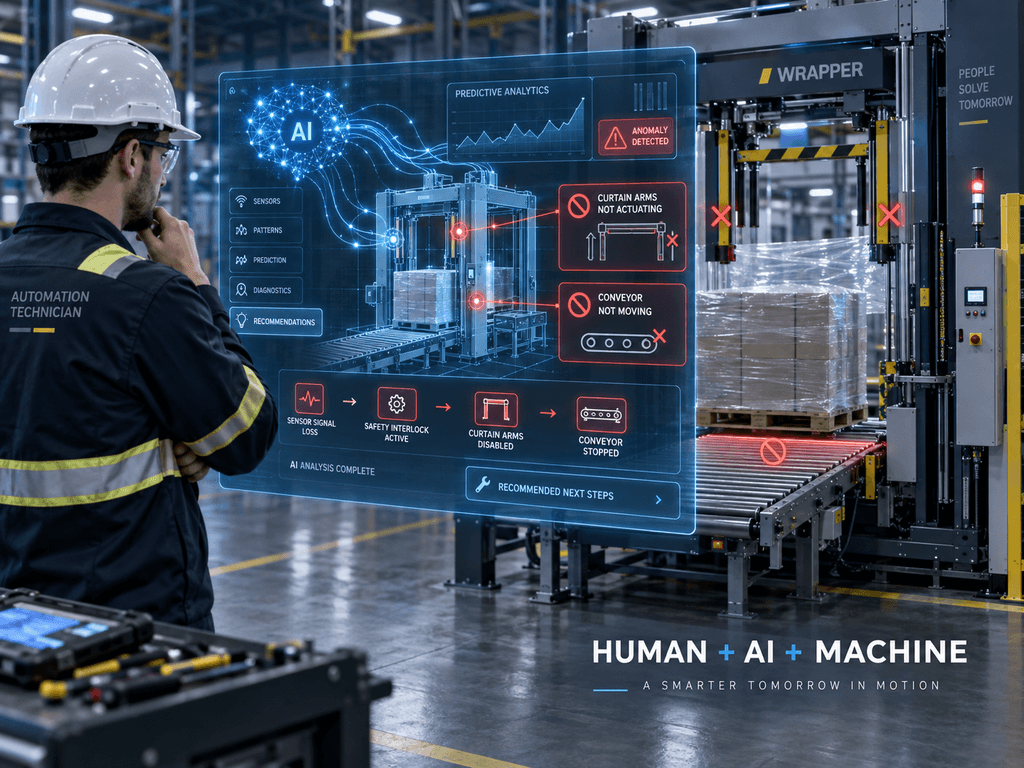
Artificial Intelligence is moving into industrial automation faster than many technicians expected.
AI is beginning to appear in engineering tools, predictive maintenance systems, digital twins, robotics, machine vision, process optimization, and industrial software.
That naturally creates a question:
Will AI eventually replace the Automation Technician?
My view is different.
AI will certainly change the profession.
It will automate some tasks.
It will accelerate programming.
It will improve diagnostics.
It will help analyze machines in ways that would take humans much longer.
But that does not automatically mean the technician disappears.
A more realistic future may look like this:
AUTOMATION TECHNICIAN
        +
        AI
        ↓
AUGMENTED TECHNICIAN
The technician of the future may actually become more capable than ever.
But the skills that make that technician valuable will change.
1. Industrial AI Is Not Science Fiction Anymore
Industrial AI is already moving beyond experimental projects.
Rockwell Automation describes industrial AI systems capable of analyzing real-time production data, detecting patterns, identifying abnormal equipment behavior, recommending maintenance actions, and even adapting control strategies as conditions change.
At the same time, industrial digital twins are increasingly being used to simulate factories, processes, robots, and equipment before changes are introduced into the physical plant. NVIDIA describes digital twins combined with AI, physics simulation, real-time production data, and sensor information as a major part of future industrial workflows.
So the important question is no longer:
“Will AI enter industrial automation?”
It already has.
The better question is:
How will technicians work with it?
2. We Are Already Seeing an Early Version of That Future
I have personally experienced a small version of this new workflow while learning and practicing industrial automation.
The process often looks like this:
TECHNICIAN
     ↓
Explains machine behavior,
process conditions,
or troubleshooting symptoms

AI
     ↓
Analyzes architecture,
logic, possible causes,
and troubleshooting paths

TECHNICIAN
     ↓
Tests the recommendation
in simulation or in the field

     ↓
Provides feedback

AI
     ↓
Refines the recommendation

     ↓
Repeat
This is not AI replacing the technician.
It is collaboration.
The AI may recognize programming patterns, propose ladder architecture, explain PLC behavior, analyze documentation, or suggest troubleshooting paths.
But the technician provides something AI cannot simply invent:
Physical observations

Electrical measurements

Actual machine behavior

Operator feedback

Process knowledge

Mechanical conditions

Safety context

Plant history
That distinction is fundamental.
AI supplies reasoning at scale. The technician supplies physical truth.
3. AI Can Help Explain Complex PLC Programs
One of the most difficult tasks for technicians is inheriting somebody else’s PLC program.
Imagine opening a large project containing:
100+ routines

Thousands of tags

Multiple operating modes

State machines

AOIs

UDTs

Produced/Consumed Tags

MSG instructions

HMI commands

Legacy logic

Multiple programmers' styles
Today, a technician may spend hours or days reconstructing how the machine works.
The future engineering workflow could be very different.
You may eventually be able to ask:
“Explain what this machine does.”
And receive something like:
Main Process:
Packaging Conveyor

Start Conditions:
- Auto Mode
- Downstream Ready
- Safety Circuit Healthy

Interlocks:
- Motor Overload
- Guard Open
- VFD Fault

Command:
Conveyor_RunCmd

Feedback:
Conveyor_RunningFB

Detected Concern:
RunCmd has multiple destructive writes
across three routines.
That type of AI-assisted program analysis could dramatically reduce the time required to understand legacy equipment.
4. Cross Reference Could Become Conversational
Today, troubleshooting might look like:
Motor does not start
        ↓
Open PLC program
        ↓
Cross Reference
        ↓
Find RunCmd
        ↓
Trace permissives
        ↓
Find missing condition
In the future, the interaction may become:
“Why can’t Pump 101 start right now?”
And the engineering system could analyze:
Pump_StartReq       = 1
Pump_PermissiveOK   = 0
Pump_Interlock      = 0
Pump_Faulted        = 0
Then continue:
Missing Permissive:
VFD_Ready = 0
Then:
VFD_Ready is false because:
Drive fault is active.
The technician still needs to understand what those conditions mean.
But instead of spending fifteen minutes finding the relevant logic, AI might identify the troubleshooting path in seconds.
That changes MTTR — Mean Time To Repair.
5. AI-Assisted Troubleshooting Could Become Extremely Powerful
Imagine a production machine stops.
Traditional troubleshooting might require checking:
PLC

HMI alarms

VFD

Network switch

Historian

Electrical drawings

Machine manual

Previous work orders
An AI-assisted diagnostic system could eventually combine all of them.
For example:
Machine stopped at 14:32:18

Motor_RunCmd disappeared
480 ms after VFD_Ready became false

Network errors increased
4 seconds before the event

Similar failure occurred twice
during the previous month
Then recommend:
Check the VFD communication path before replacing the motor or starter.
That does not repair the machine.
But it gives the technician a much stronger starting point.
6. The Technician Still Has to Touch the Machine
This part cannot be forgotten.
AI may say:
“Likely control-power failure.”
But someone still needs to check:
24 VDC?

120 VAC?

480 VAC?

Fuse?

Breaker?

Terminal?

Relay?

Contactor coil?

Loose wire?
AI cannot measure a terminal unless sensors or connected diagnostic equipment provide that information.
The technician still owns the physical layer.
That includes:
Voltage

Current

Mechanical movement

Air pressure

Valve position

Sensor alignment

Cable condition

Heat

Noise

Vibration

Smell
Those physical observations remain extremely important.
7. AI Can Be Wrong
This may be the most important warning in the entire discussion.
Suppose AI sees:
RunCmd = 1
RunningFB = 0
and concludes:
“Motor starter failure.”
The technician investigates and finds:
Broken mechanical couplingThe motor was actually running.
The process was not moving.
That means the AI diagnosis was plausible—but incomplete.
This is why automation cannot become:
AI recommendation
       ↓
Blind execution
The safer model is:
AI recommendation
       ↓
Technician validation
       ↓
Physical verification
       ↓
Decision
8. AI Will Probably Generate More PLC Code
Another major change is code generation.
Instead of manually creating every rung, an engineer may increasingly describe the required behavior:
Create a pump control module with Manual and Auto modes, Start Request, Stop Request, permissives, interlocks, Run Command, Running Feedback, Failed-to-Start detection, fault reset, alarm status, and HMI diagnostics.
AI could generate much of the initial structure.
The result might resemble:
REQUEST
   ↓
PERMISSIVES
   ↓
INTERLOCKS
   ↓
COMMAND
   ↓
OUTPUT
   ↓
FEEDBACK
   ↓
FAULT
   ↓
ALARM
That could save significant engineering time.
But there is a critical distinction:
AI-generated code is not automatically production-ready code.
9. Generated Does Not Mean Approved
Industrial control software affects physical equipment.
A programming mistake can result in:
Equipment damage

Product loss

Unexpected motion

Process instability

Production downtime

Safety risk
So the future workflow should look more like:
AI generates proposal
        ↓
Engineer / Technician review
        ↓
Simulation
        ↓
Testing
        ↓
Safety verification
        ↓
Approval
        ↓
Controlled deployment
AI can accelerate engineering.
It should not eliminate engineering discipline.
10. Real-Time AI Modifications Will Need Boundaries
Another interesting future question is:
Could AI modify PLC logic while the machine is running?
Technically, more automated optimization is likely.
But I expect different levels of authority.
Level 1 — Recommend
AI:
"I recommend increasing this
verification time from 2.0 to 2.5 seconds."
Human decides.
Level 2 — Prepare
AI:
"I created the proposed change."
Human reviews it.
Level 3 — Simulate
AI:
"I tested the change against
these operating scenarios."
Human validates the results.
Level 4 — Controlled Deployment
AI proposal
    ↓
Approval workflow
    ↓
Download
    ↓
Validation
Level 5 — Limited Autonomous Optimization
For selected non-safety-critical applications:
AI adjusts:
Process setpoints
Energy usage
Production scheduling
Optimization parameters
within carefully defined limits.
This is much more realistic than allowing AI unrestricted access to production logic.
11. Safety Must Remain a Hard Boundary
Imagine an AI system analyzing production and determining:
“This interlock reduces throughput by 8%.”
That does not mean:
Remove the interlock.
Industrial AI must operate inside constraints.
For example:
AI Optimization
      ↓
Allowed operating envelope
      ↓
Process constraints
      ↓
Machine protection
      ↓
Safety architecture
The safety system should not simply become another variable for optimization.
Functions involving:
Emergency Stops

Guarding

Safe Torque Off

Safety Relays

Safety PLCs

Personnel Protection
require deterministic engineering, verification, standards compliance, and controlled change management.
12. Machine Learning Will Change Fault Detection
Traditional PLC diagnostics often depend on fixed thresholds.
For example:
Motor Current > 20 A
       ↓
Alarm / Fault
That works.
But machine learning can evaluate a much larger behavioral pattern.
Imagine monitoring:
Current

Vibration

Temperature

Torque

Speed

Production Load

Operating Hours

Historical Data
Then AI detects:
“This motor is still operating inside normal limits, but its vibration/current relationship has shifted significantly from its historical baseline.”
That is a different kind of maintenance.
Rockwell describes industrial maintenance systems that use real-time data and historical patterns to detect anomalies, identify likely failure modes, and recommend maintenance before production is affected.
13. Maintenance Could Move from Reactive to Predictive
Traditional maintenance often looks like:
Machine fails
      ↓
Alarm
      ↓
Technician called
      ↓
Troubleshoot
      ↓
Repair
Predictive maintenance moves toward:
Machine behavior changes
      ↓
AI detects anomaly
      ↓
Maintenance notified
      ↓
Technician verifies
      ↓
Repair scheduled
      ↓
Failure avoided
That is potentially a major improvement.
But notice:
The technician did not disappear.
The technician moved earlier in the timeline.
14. Digital Twins Could Change How PLC Changes Are Tested
Today, we already use simulation and emulation to learn and validate logic.
The next step is much more sophisticated:
PLC Program
      +
Machine Model
      +
Physics
      +
Process Data
      +
AI
      ↓
Digital Twin
A proposed change could potentially be tested against thousands of scenarios before production.
NVIDIA is actively positioning industrial digital twins as tools for simulation, design, operational optimization, AI validation, and testing industrial systems before deployment in the physical world.
Imagine changing a sequence and automatically testing:
Normal operation

Sensor stuck ON

Sensor stuck OFF

VFD fault

Blocked conveyor

Valve failure

Power loss

Network loss

Operator Stop

Mode transition

Recovery after fault
before touching the production machine.
That could transform commissioning.
15. Digital Twins May Become the Safe Playground for AI
This could also solve one of the biggest problems with autonomous industrial AI.
Instead of:
AI learns
    ↓
Production machine
we can use:
AI proposes
    ↓
Digital Twin
    ↓
Test
    ↓
Validate
    ↓
Human review
    ↓
Production
That creates a much safer learning environment.
The physical plant should not be where AI experiments blindly.
16. Physical AI Will Expand Robotics and Machine Vision
Another major area is Physical AI.
This refers to AI systems that interact with the physical world through robots, cameras, sensors, vehicles, and industrial equipment.
Modern manufacturing initiatives are combining AI with robotics, machine vision, digital twins, real-time sensor data, and simulation so systems can perceive their environment and make more intelligent decisions.
That could affect:
Robotic picking

Machine loading

Quality inspection

Autonomous material handling

Warehouse operations

Vision-guided assembly

Predictive maintenance
The Automation Technician increasingly becomes responsible for systems that combine classical automation with AI-driven behavior.
17. The PLC Is Not Going Away Tomorrow
Despite all of this, deterministic control still matters.
PLCs are extremely good at:
Scan-based control

Deterministic execution

Machine sequencing

Interlocks

Industrial I/O

High availability

Reliable field control
AI is good at different things:
Pattern recognition

Large-scale analysis

Prediction

Optimization

Natural-language interaction

Complex correlation
The strongest architecture may combine both.
AI
  ↓
Analysis / Recommendation / Optimization

PLC
  ↓
Deterministic Machine Control
Each technology doing what it does best.
18. Human + AI + Machine
The future should not be framed only as:
HUMAN
vs.
AI
A more useful model is:
             AI
           /    \
          /      \
TECHNICIAN ------ MACHINE
The machine generates data.
AI analyzes patterns.
The technician provides physical context.
The PLC controls deterministic behavior.
The technician validates AI conclusions.
The feedback improves future diagnostics.
That becomes a loop.
19. The Technician Becomes the Reality Check
AI may understand:
Tag values

Alarm history

Trend data

Machine documentation

Network diagnostics

PLC code
The technician understands:
"That valve sounds wrong."

"The drawing is outdated."

"The operator changed this last week."

"The sensor bracket is loose."

"That motor normally draws more current."

"This problem only happens during washdown."
That contextual knowledge is incredibly valuable.
The future technician may increasingly become the person who connects digital intelligence with physical reality.
20. AI Changes What Technicians Should Learn
A technician who only knows:
XIC
XIO
OTE
TON
will probably become increasingly limited.
The future skill stack looks more like:
PLC
+
Electrical
+
VFD
+
Instrumentation
+
Industrial Networks
+
HMI / SCADA
+
Process Knowledge
+
Data
+
AI
That does not mean every technician must become a data scientist.
It means technicians should understand enough to work with intelligent systems.
21. Future Troubleshooting Questions Will Change
Today we ask:
Why is this output OFF?
Tomorrow we may also ask:
Why did the AI classify this equipment as abnormal?
Which sensor data influenced the recommendation?
Was the data valid?
Did the model see the same operating condition before?
Is the recommendation safe?
Is the AI seeing correlation or actual causation?
Who approved this automated change?
Those become controls questions too.
22. Sensor Quality Becomes Even More Important
AI is only as good as its information.
Consider:
Bad Sensor
     ↓
Bad Data
     ↓
AI Analysis
     ↓
Bad Recommendation
The old automation principle still applies:
Garbage in, garbage out.
This means instrumentation knowledge may become more valuable, not less.
The technician who knows how to verify:
4–20 mA

0–10 V

RTD

Load Cell

Encoder

Flow

Pressure

Vibration
becomes critical to AI-enabled systems.
23. Networking Also Becomes More Important
AI-enabled automation requires information movement.
That means:
PLC
↓
Industrial Ethernet
↓
SCADA
↓
Historian
↓
Edge Computer
↓
AI Platform
A technician who understands:
EtherNet/IP

Managed Switches

VLANs

Fiber

OPC UA

Network Diagnostics

Cybersecurity
will be increasingly valuable.
The smarter the plant becomes, the more dependent it becomes on reliable infrastructure.
24. Cybersecurity Becomes Part of the AI Conversation
If AI can eventually:
Read PLC logic

Analyze production

Recommend changes

Generate code

Interact with engineering systems
then access control becomes extremely important.
The questions become:
Who can ask AI to make changes?

What systems can AI access?

Can it write or only read?

Who approves changes?

Are actions logged?

Can recommendations be reproduced?

What happens if the AI service is compromised?
The future of AI in automation is also a cybersecurity discussion.
25. AI Can Accelerate Learning
There is another side of this discussion that matters for new technicians.
AI can become a powerful technical tutor.
A technician can ask:
Explain this rung.
Why is this interlock XIO?
What’s the difference between feedback and command?
Explain this PowerFlex fault.
Walk me through this Stratix topology.
Help me understand this machine sequence.
That can dramatically accelerate learning.
But the student still needs to:
Build it

Test it

Measure it

Break it

Troubleshoot it

Understand it
AI can shorten the learning loop.
It cannot replace the learning loop.
26. This Is Already Changing How I Learn Automation
My own learning process demonstrates this.
I can work through a PLC project with AI:
Define the process

Create architecture

Build ladder

Simulate

Test abnormal conditions

Find problems

Modify logic

Retest

Document
The AI can explain why a rung is behaving a certain way.
But simulation or plant feedback may reveal:
“That does not work the way we expected.”
Then the design gets corrected.
That feedback is not failure.
It is the learning process.
And it demonstrates something important:
AI becomes most useful when the human is actively questioning and validating it.
27. The Strongest Technician Will Not Be the One Who Blindly Trusts AI
The strongest technician will be the person who can say:
“That recommendation makes sense.”
or:
“That recommendation doesn’t match what the machine is actually doing.”
That requires fundamentals.
Without fundamentals, AI becomes a black box.
With fundamentals, AI becomes a tool.
28. Think of AI Like a Very Powerful Instrument
A multimeter does not replace an electrician.
A laptop does not replace a PLC technician.
A thermal camera does not replace troubleshooting knowledge.
They extend what the technician can see.
AI may become another instrument—except one capable of analyzing huge amounts of information.
The technician still needs to interpret the result.
29. What Skills Should Automation Technicians Focus On Now?
If I were preparing for the next several years, I would prioritize:
Strong PLC Fundamentals
Ladder Logic
State Machines
Sequences
UDTs
AOIs
Diagnostics
Electrical Fundamentals
Control Circuits
Motors
Contactors
Overloads
24 VDC
120 VAC
480 VAC
Drives
VFD Setup
Faults
Feedback
Networking
Motor Control
Industrial Networking
EtherNet/IP
Managed Switches
VLANs
Fiber
OPC UA
Instrumentation
Analog Signals
Sensors
Scaling
Calibration
Process Measurements
HMI / SCADA
Alarms
Trends
Historian
Security
Scripts
Troubleshooting
Systematic diagnosis
Root cause analysis
Electrical measurement
Logic tracing
Process understanding
AI Literacy
Prompting

Validation

Data quality

Model limitations

AI-assisted diagnostics

AI-assisted engineering
That combination will be powerful.
30. What AI Probably Will Replace
We should also be realistic.
AI may reduce the amount of time humans spend on repetitive engineering tasks.
Examples may include:
Boilerplate ladder logic

Documentation

Tag descriptions

Alarm text generation

Routine templates

Basic code conversion

Cross-reference analysis

Initial troubleshooting summaries

Report generation
That is not necessarily bad.
It allows the technician to spend more time on higher-value work:
Diagnosis

Architecture

Validation

Commissioning

Safety

Process understanding

Physical troubleshooting
31. What Becomes More Valuable
As routine programming becomes easier, professional value may shift toward:
Can you understand the whole machine?

Can you identify bad AI recommendations?

Can you validate a control change?

Can you troubleshoot across disciplines?

Can you recognize unsafe behavior?

Can you communicate with operators and engineers?

Can you determine root cause?
Those are much harder to automate.
32. The Profession May Become More Interesting, Not Less
Instead of spending hours manually creating repetitive code, technicians may spend more time solving higher-level problems.
Instead of manually searching twenty routines, AI may identify the relevant logic.
Instead of waiting for equipment failure, predictive systems may identify degradation early.
Instead of testing changes directly on production equipment, digital twins may allow much more testing beforehand.
That could create a profession where technicians have better tools and deeper visibility into the systems they maintain.
33. But Fundamentals Become More Important, Not Less
This may sound contradictory.
If AI can generate PLC code, why learn PLC programming?
Because someone has to determine whether the generated code is correct.
If AI recommends changing:
Permissive logicyou need to understand permissives.
If AI modifies:
Interlock logicyou need to understand interlocks.
If AI creates:
State Machineyou need to understand state machines.
Otherwise you cannot validate anything.
AI raises the ceiling.
But it also raises the importance of fundamentals.
34. The Technician Who Refuses AI May Eventually Be at a Disadvantage
This does not mean every new AI tool should be trusted.
Healthy skepticism is important.
But completely ignoring AI could become similar to refusing to learn:
PLC software

VFD configuration

Industrial Ethernet

SCADA
because the older technology already works.
Industries evolve.
Technicians evolve with them.
35. The Technician Who Blindly Trusts AI Will Also Be at a Disadvantage
The opposite extreme is equally dangerous.
AI said it
↓
Therefore it must be correct
is not acceptable industrial reasoning.
The correct mindset is:
AI recommendation
       ↓
Does it make technical sense?
       ↓
Does it match the process?
       ↓
Does it match field conditions?
       ↓
Is it safe?
       ↓
Can I verify it?
That is professional judgment.
36. The Future Is Not AI vs. Technician
The more useful question is:
What can an Automation Technician accomplish when AI becomes part of the toolbox?
Potentially much more.
Technician Experience

+ PLC Knowledge

+ Electrical Knowledge

+ Process Knowledge

+ AI Analysis

= Faster and Better Decisions
The combination matters.
37. A Possible Future Troubleshooting Workflow
Imagine a plant call:
“Packaging Line 2 keeps stopping.”
The future technician might receive:
AI Diagnostic Summary

• 6 stops occurred in the last 8 hours
• All followed Photoeye_12 signal instability
• VFD and network remained healthy
• Signal toggled 14 times within 280 ms
• Similar event occurred after washdown last week
• Likely causes:
  1. Sensor contamination
  2. Alignment
  3. Loose connector
Then the technician goes to the machine.
Checks the photoeye.
Finds moisture inside the connector.
Repairs it.
Confirms stable input.
Production resumes.
AI did not replace the technician.
It helped the technician arrive at the likely failure faster.
38. The Human Still Closes the Loop
The most important final step is:
Repair completed
      ↓
Technician confirms root cause
      ↓
Feedback returned to system
      ↓
Future AI diagnosis improves
Now AI and technician learn together.
That is where this becomes extremely powerful.
39. The Real Debate
Will AI replace some automation tasks?
Almost certainly.
Will it change PLC programming?
Yes.
Will diagnostics become more automated?
Very likely.
Will industrial systems become more adaptive and predictive?
That transition is already underway.
Will that make the skilled Automation Technician irrelevant?
I do not believe so.
It changes the job.
The technician increasingly becomes:
Physical Systems Expert

Troubleshooter

AI Validator

Control Systems Specialist

Process Interpreter

Cyber-Physical Problem Solver
That may actually make the role more sophisticated.
Final Thought
AI should not be viewed only as a competitor to the Automation Technician.
It may become one of the most powerful tools the technician has ever received.
But tools do not replace fundamentals.
The future technician will still need to understand:
Electricity

PLC Logic

Machines

Processes

Networks

Instrumentation

Safety
AI can analyze faster.
AI can recognize patterns.
AI can generate code.
AI can suggest causes.
AI can help teach.
But the technician still stands in front of the actual machine.
The technician sees what is physically happening.
The technician validates the recommendation.
The technician understands the consequences of changing the system.
And the technician ultimately connects the digital world with physical reality.
AI supplies reasoning at scale. The technician supplies physical truth.
That relationship may define the next generation of industrial automation.
So the question may not be:
“Will AI replace Automation Technicians?”
A better question is:
“How much more capable can an Automation Technician become by learning how to work with AI?”
My prediction is that the strongest future belongs neither to AI alone nor to technicians who ignore it.
It belongs to technicians who understand the fundamentals deeply enough to use AI intelligently, challenge it when necessary, validate it against the real machine, and turn its speed into better industrial decisions.
The future is not Human vs. AI.
It is Human + AI + Machine.
Montserrat Clay
Your words have a way of touching hearts and inspiring minds Thank you for using your platform to spread love and positivity