1. What Is Industrial Cybersecurity and Why Should Automation Technicians Care?
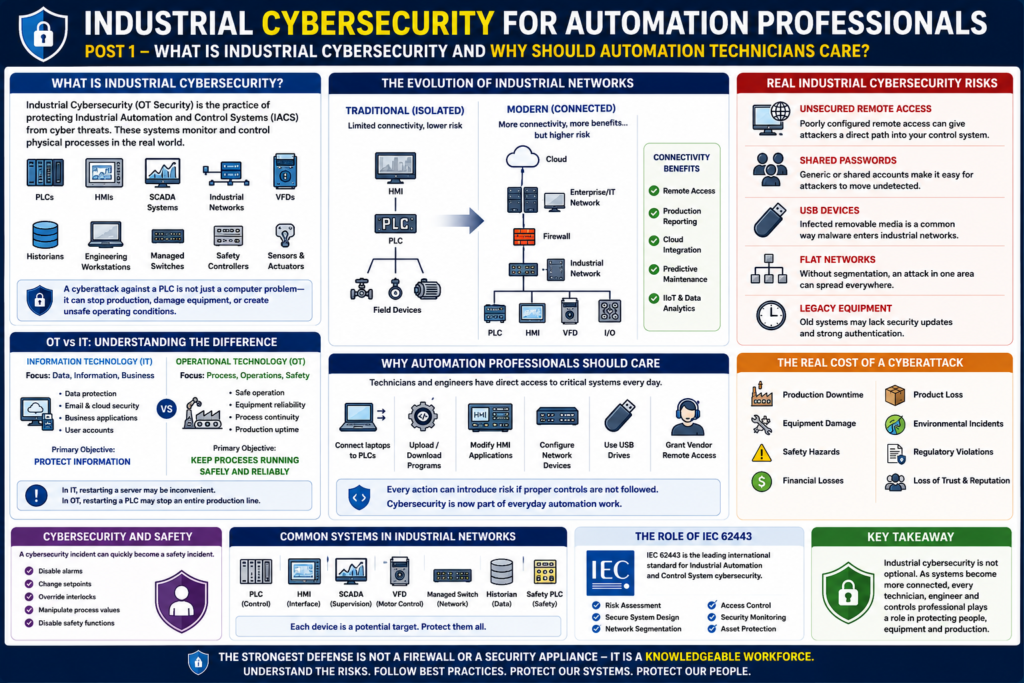
Industrial cybersecurity is no longer a topic reserved for IT departments or cybersecurity specialists. Today, automation technicians, controls engineers, maintenance personnel, and industrial electricians interact daily with systems that are potential cyberattack targets.
Modern manufacturing facilities rely on interconnected networks of PLCs, HMIs, SCADA systems, VFDs, industrial switches, historians, and remote access solutions. While this connectivity improves efficiency and visibility, it also creates new risks that can impact production, equipment, and safety.
Understanding the fundamentals of industrial cybersecurity is becoming just as important as understanding PLC programming, motor control, or industrial networking.
What Is Industrial Cybersecurity?
Industrial Cybersecurity, often referred to as OT Security (Operational Technology Security), is the practice of protecting Industrial Automation and Control Systems (IACS) from cyber threats.
These systems include:
- PLCs
- HMIs
- SCADA Systems
- Industrial Networks
- Managed Switches
- Engineering Workstations
- VFDs
- Safety Controllers
- Historians
- Remote I/O Systems
- Sensors and Actuators
Unlike traditional IT systems, these devices directly interact with physical equipment and industrial processes.
A cyberattack against a PLC is not just a computer problem—it can stop a production line, damage equipment, or create unsafe operating conditions.
Why Automation Technicians Need Cybersecurity Knowledge
Many technicians assume cybersecurity is handled by the IT department.
In reality, automation personnel often have direct access to the most critical systems in a facility.
Consider how often technicians:
- Connect laptops to PLCs
- Upload or download PLC programs
- Modify HMI applications
- Configure managed switches
- Change network settings
- Use USB drives
- Grant vendor remote access
- Troubleshoot communication issues
Every one of these activities can introduce cybersecurity risks if proper controls are not followed.
Cybersecurity is now part of everyday automation work.
OT vs IT: Understanding the Difference
One of the biggest mistakes organizations make is assuming OT cybersecurity is the same as IT cybersecurity.
While both aim to protect systems, their priorities are very different.
Information Technology (IT)
Focuses on:
- Data protection
- Email security
- Business applications
- User accounts
- Cloud services
Primary objective:
Protect information.
Operational Technology (OT)
Focuses on:
- Safe operation
- Equipment reliability
- Process continuity
- Production uptime
- Human safety
Primary objective:
Keep industrial processes running safely and reliably.
For IT, restarting a server may be inconvenient.
For OT, restarting a PLC may stop an entire production line.
The Real Cost of a Cyberattack
When people think about cyberattacks, they often think about stolen data.
In industrial environments, the consequences can be much more serious.
A successful cyberattack may cause:
- Production downtime
- Equipment damage
- Product loss
- Environmental incidents
- Safety hazards
- Regulatory violations
- Financial losses
- Loss of customer trust
In many industries, a few hours of downtime can cost tens or hundreds of thousands of dollars.
Real Industrial Cybersecurity Risks
Most industrial facilities face common cybersecurity risks every day.
Unsecured Remote Access
Vendors often need remote access to:
- PLCs
- HMIs
- SCADA systems
Poorly configured remote access can provide attackers with a direct path into the control system.
Shared Passwords
Many facilities still use:
- Generic maintenance accounts
- Shared engineering passwords
- Default device credentials
This makes accountability and access control difficult.
USB Devices
Technicians frequently use USB drives for:
- PLC backups
- Firmware updates
- HMI projects
Infected removable media remains a common attack vector.
Flat Networks
A flat network occurs when everything exists on the same network:
- Office computers
- PLCs
- HMIs
- SCADA servers
Without segmentation, a compromise in one area can quickly spread throughout the facility.
Legacy Equipment
Many industrial systems remain in service for decades.
These devices may:
- Run unsupported operating systems
- Lack security updates
- Have weak authentication controls
Protecting legacy equipment is one of the biggest challenges in OT cybersecurity.
Cybersecurity and Safety
Industrial cybersecurity is not just about protecting computers.
It is also about protecting people.
Imagine if an attacker could:
- Disable alarms
- Change setpoints
- Override interlocks
- Manipulate process values
- Disable safety functions
A cybersecurity incident can quickly become a safety incident.
This is one reason why Safety Instrumented Systems (SIS) often have additional layers of protection and isolation.
Common Systems Found in Industrial Networks
A typical industrial network may contain:
| Device | Function |
|---|---|
| PLC | Controls equipment |
| HMI | Operator interface |
| SCADA | Supervisory control |
| VFD | Motor speed control |
| Managed Switch | Network infrastructure |
| Historian | Data collection |
| Engineering Workstation | Programming and configuration |
| Safety PLC | Functional safety control |
Each of these devices represents a potential cybersecurity target.
The Evolution of Industrial Networks
Years ago, most control systems were isolated.
Today, facilities often require:
- ERP integration (Enterprise Resource Planning) is software used to manage business operations.
- Production reporting
- Cloud connectivity
- Remote support
- Predictive maintenance
- IIoT devices
This increased connectivity provides tremendous benefits but also increases the attack surface.
Modern cybersecurity must balance connectivity with protection.
The Role of IEC 62443
As industrial cybersecurity became more important, the industry needed a standard specifically designed for automation systems.
This led to the development of:
IEC 62443
IEC 62443 is the leading international standard for Industrial Automation and Control System cybersecurity.
It provides guidance for:
- Risk assessment
- Network segmentation
- Secure system design
- Access control
- Security monitoring
- Asset protection
Throughout this series, we will frequently reference IEC 62443 because it forms the foundation of modern OT cybersecurity programs.
What Will You Learn in This Series?
In the upcoming posts, we will explore:
- The Purdue Model
- Zones and Conduits
- Defense in Depth
- Industrial Firewalls
- VLAN Segmentation
- OT DMZ Architecture
- Secure Remote Access
- Security Levels (SL1-SL4)
- PLC Hardening
- HMI Security
- Industrial Switch Security
- Incident Response
- Backups and Disaster Recovery
- Cybersecurity and Functional Safety
The goal is not to turn automation professionals into cybersecurity experts overnight.
The goal is to help technicians, engineers, and maintenance personnel understand how cybersecurity affects the systems they work with every day.
Final Thoughts
Industrial cybersecurity is no longer optional in modern manufacturing environments.
As automation systems become more connected, every technician, engineer, and controls professional plays a role in protecting critical assets and ensuring safe operations.
Understanding cybersecurity fundamentals is becoming just as important as understanding PLC programming, industrial networking, instrumentation, and troubleshooting.
The strongest defense is not a firewall or a security appliance—it is a knowledgeable workforce that understands both automation and cybersecurity.