2. Understanding Hazardous Areas and Intrinsic Safety
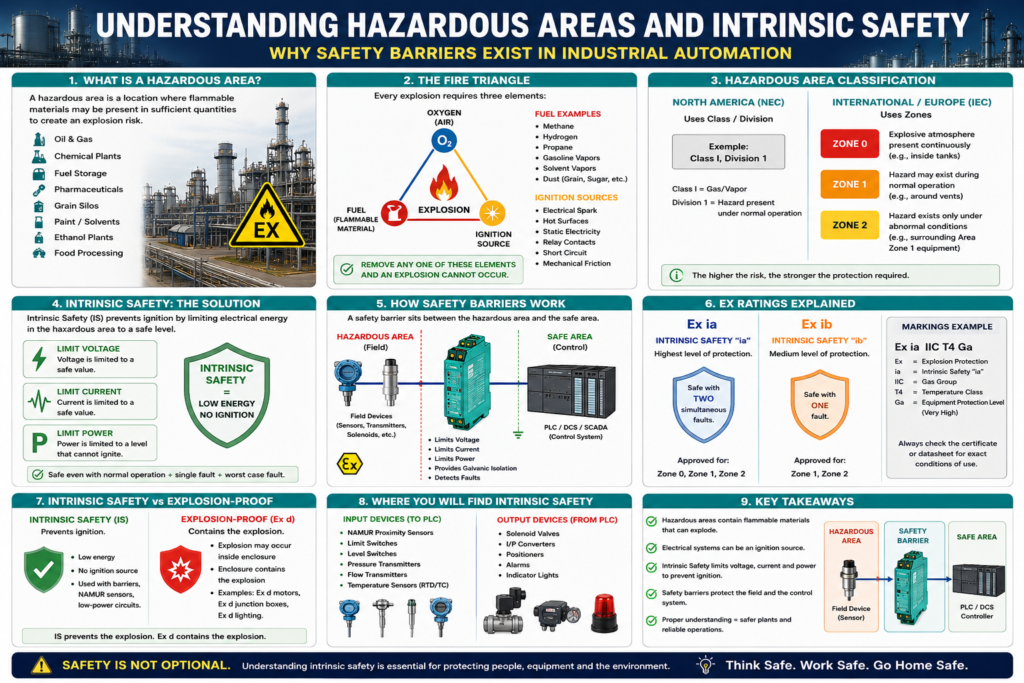
Why Safety Barriers Exist in Industrial Automation
Introduction
Many automation technicians encounter safety barriers, NAMUR sensors, intrinsically safe circuits, and hazardous area classifications throughout their careers. However, many people learn how to wire these devices without fully understanding why they are required.
Before understanding isolated barriers, it is important to understand the problem they are designed to solve.
The purpose of intrinsic safety is simple:
Prevent electrical equipment from becoming an ignition source in an explosive atmosphere.
This article explains hazardous areas, ignition risks, intrinsic safety concepts, and how safety barriers protect people, equipment, and facilities.
What Is a Hazardous Area?
A hazardous area is a location where flammable materials may be present in sufficient quantities to create an explosion risk.
Examples include:
- Oil and gas facilities
- Chemical plants
- Fuel storage terminals
- Pharmaceutical plants
- Grain silos
- Food processing facilities
- Paint manufacturing facilities
- Ethanol plants
In these environments, dangerous materials may exist as:
- Gas
- Vapor
- Mist
- Dust
When mixed with oxygen and exposed to an ignition source, an explosion can occur.
The Fire Triangle
Every explosion requires three elements:
          OXYGEN
             ▲
             │
             │
FUEL ◄──────► IGNITION
Remove any one of these elements and combustion cannot occur.
Examples:
Fuel
- Methane
- Hydrogen
- Propane
- Gasoline vapors
- Grain dust
- Sugar dust
Oxygen
Normally present in air.
Ignition Source
Can be:
- Electrical spark
- Hot surface
- Static electricity
- Relay contact
- Motor brush
- Short circuit
Why Electrical Systems Can Be Dangerous
A normal PLC input card may operate at:
24 VDCA relay output may switch:
120 VAC
240 VAC
A short circuit, loose connection, or switching contact can generate:
Spark
Arc
Heat
In a hazardous atmosphere, that may be enough to trigger an explosion.
Real Industrial Example
Imagine a level switch installed on a solvent storage tank.
Storage Tank
      │
      │
Level Switch
      │
      │
PLC
Without protection:
- Wire short circuit
- Terminal looseness
- Electrical fault
may create a spark near flammable vapors.
The result could be catastrophic.
Area Classification
Industries classify locations according to risk.
North America
Uses:
- Class
- Division
Example:
Class I Division 1Meaning:
- Class I = Gas/Vapor
- Division 1 = Hazard present under normal operation
Europe and International Standards
Uses:
- Zones
Example:
Zone 0
Zone 1
Zone 2
Hazardous Area Zones
Zone 0
Most dangerous.
Explosive atmosphere exists continuously.
Examples:
- Inside fuel tanks
- Inside chemical vessels
Zone 1
Hazard may exist during normal operation.
Examples:
- Around tank vents
- Around process equipment
Zone 2
Hazard exists only under abnormal conditions.
Examples:
- Areas surrounding Zone 1 equipment
The Challenge
Automation systems need information from hazardous areas.
Examples:
Pressure
Temperature
Flow
Level
Position
Sensors must communicate with:
PLC
DCS
SCADA
The question becomes:
How can we safely connect electronics to an explosive environment?
Intrinsic Safety: The Solution
Intrinsic Safety (IS) is one of the most widely used protection methods.
Instead of containing an explosion, it prevents one from occurring.
The principle is simple:
Limit Voltage
Limit Current
Limit Power
to a level incapable of ignition.
Pepperl+Fuchs describes isolated barriers as devices that provide current, voltage, and power limitation while maintaining isolation between the field circuit and the control system.
What Does “Intrinsically Safe” Mean?
An intrinsically safe circuit is designed so that:
Normal Operation
+
Single Fault
+
Worst Case Fault
still cannot generate enough energy to ignite the atmosphere.
That is the key concept.
The circuit remains safe even during failures.
How Safety Barriers Help
A barrier sits between:
Hazardous Area
       │
       │
Safety Barrier
       │
       │
PLC
The barrier continuously limits:
- Voltage
- Current
- Power
before energy reaches the hazardous area.
Understanding Ex Ratings
You will often see markings like:
Ex ia
Ex ib
Ex
Means:
Explosion ProtectionEx ia
Highest level of intrinsic safety.
Safe with:
Two simultaneous faultsTypically approved for:
Zone 0
Zone 1
Zone 2
Ex ib
Safe with:
One faultTypically approved for:
Zone 1
Zone 2
Intrinsic Safety vs Explosion-Proof
Many technicians confuse these concepts.
Intrinsic Safety
Prevents ignition.
Low Energy
No Ignition
Uses:
- Barriers
- NAMUR sensors
- Low-power circuits
Explosion-Proof
Allows an explosion to occur inside an enclosure.
The enclosure contains the explosion.
Examples:
- Explosion-proof motors
- Explosion-proof junction boxes
- Explosion-proof lighting
Why Intrinsic Safety Is Popular
Advantages include:
Easier Maintenance
Technicians can often troubleshoot without shutting down large portions of the plant.
Lower Installation Cost
Smaller wiring methods.
Better Diagnostics
Modern barriers can detect:
- Open wires
- Short circuits
- Device faults
and report them to the control system.
Greater Flexibility
Easy integration with:
- PLCs
- DCS systems
- SCADA systems
Where Technicians Encounter Intrinsic Safety
Common field devices include:
Sensors
- NAMUR Proximity Sensors
- Limit Switches
- Level Switches
Analog Instruments
- Pressure Transmitters
- Flow Transmitters
- Temperature Transmitters
Output Devices
- Solenoid Valves
- I/P Converters
- Positioners
Practical Troubleshooting Mindset
When working with hazardous area instrumentation:
Always think:
Field Device
      ↓
Barrier
      ↓
PLC
If a signal disappears:
- Verify sensor operation
- Verify barrier power
- Verify barrier LEDs
- Verify wiring
- Verify PLC input
Never assume the barrier is bad until the complete signal path is checked.
Common Mistakes New Technicians Make
Mistake 1
Assuming every green module is the same.
Different barriers perform different functions.
Mistake 2
Changing DIP switch settings without documenting them.
Always take a photo first.
Mistake 3
Bypassing safety barriers.
Never bypass intrinsic safety devices.
Mistake 4
Ignoring flashing red fault LEDs.
A flashing fault LED often indicates:
- Broken wire
- Short circuit
- Sensor problem
rather than a failed barrier.
Final Thoughts
Hazardous area protection is not simply a regulatory requirement—it is a fundamental part of industrial safety.
Intrinsic safety works by limiting electrical energy before it can become an ignition source. Safety barriers, isolated barriers, and intrinsically safe circuits allow automation systems to safely communicate with field devices located in potentially explosive atmospheres.
Understanding hazardous areas first makes it much easier to understand:
- NAMUR sensors
- Safety barriers
- Line fault detection
- Galvanic isolation
- Advanced troubleshooting techniques
These concepts form the foundation of modern process automation and industrial instrumentation.