14. Control Transformers in Industrial Motor Control (14 of 22)
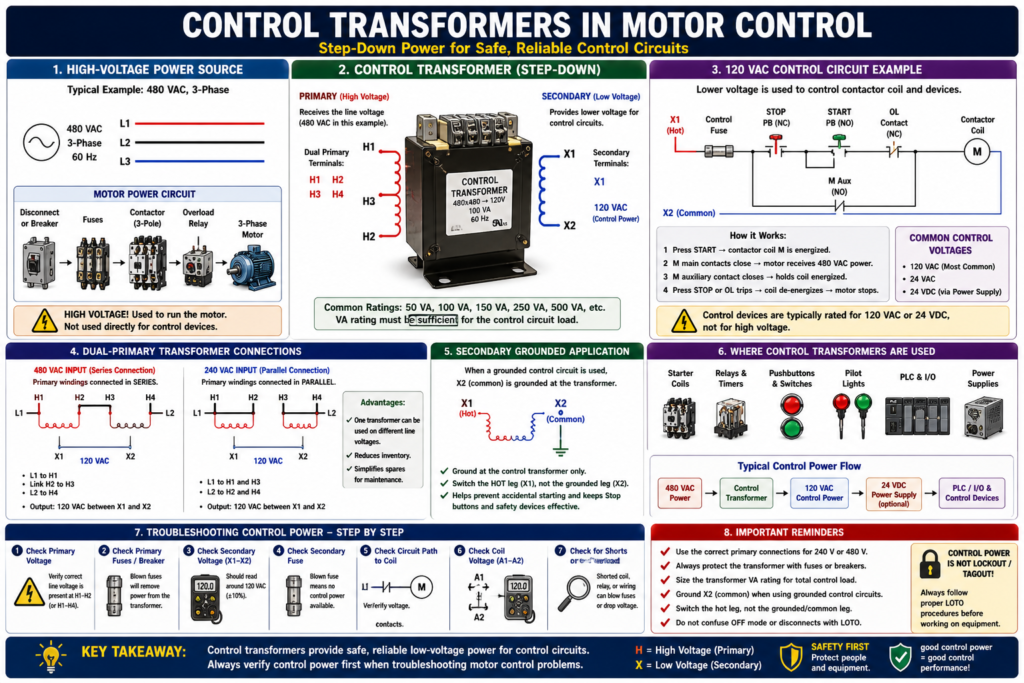
Why We Use Lower Voltage Control Circuits
Introduction
In industrial motor control panels, it is very common to see a motor powered by a high-voltage circuit, while the control circuit operates at a lower voltage.
For example:
Motor Power Circuit: 480 VAC, 3-phase
Control Circuit: 120 VAC
This is where the control transformer becomes important.
A control transformer is used to step down a higher voltage to a lower voltage that can be used by control devices such as pushbuttons, pilot lights, contactor coils, relays, timers, and sometimes control power supplies.
A simple way to understand it is:
The motor may run on 480 VAC, but the control circuit often uses 120 VAC because it is easier and safer to control.
The motor control textbook explains that motor control transformers are designed to reduce supply voltage for motor control circuits. It also notes that many commercial and industrial motors operate from 208–600 VAC systems, while their control systems commonly operate at 120 VAC.
What Is a Control Transformer?
A control transformer is a step-down transformer used to provide a lower control voltage from a higher power source.
Typical examples:
480 VAC → 120 VAC
240 VAC → 120 VAC
480 VAC → 24 VAC
In motor control, the transformer usually has:
Primary side = high-voltage input
Secondary side = lower-voltage output
Common transformer terminal markings:
H terminals = primary / high-voltage side
X terminals = secondary / low-voltage side
On power transformers, high-voltage winding leads are marked H1 and H2, while low-voltage winding leads are marked X1 and X2.
Why Use a Control Transformer?
A control transformer is used for several important reasons.
1. Lower Control Voltage
Instead of running all pushbuttons, relay coils, and pilot lights at 480 VAC, the transformer provides a lower voltage such as 120 VAC.
This makes the control circuit more practical.
The textbook explains that higher-voltage control circuits can be more lethal than 120 V, and that light-duty contacts such as stop buttons or relay contacts may weld before a protective device clears a short circuit in some high-voltage control systems.
2. Separation Between Power and Control
The motor power circuit carries high motor current.
The control circuit only needs enough current for control devices.
Example:
Power Circuit:
L1/L2/L3 → Contactor → Overload → Motor

Control Circuit:
Control Transformer → Stop PB → Start PB → OL Contact → Contactor Coil
This separation makes troubleshooting easier.
3. Compatibility with Control Components
Many control devices are rated for 120 VAC or 24 VDC, not 480 VAC.
Examples:
- Start pushbuttons
- Stop pushbuttons
- Pilot lights
- Contactors coils
- Relay coils
- Timer relays
- Control relays
- PLC input circuits
- Interposing relays
Step-down control transformers are installed when control circuit components are not rated for the line voltage.
4. Easier Troubleshooting
A lower-voltage control circuit is easier to trace and troubleshoot than a high-voltage control circuit.
A technician can separate the problem into:
Power circuit problem?
Control transformer problem?
Control circuit problem?
Contactor coil problem?
Motor power problem?
This is a key troubleshooting mindset.
Primary Side and Secondary Side
A transformer has two main sides:
Primary Side
The primary side receives the source voltage.
Example:
480 VAC inputCommon primary terminals:
H1, H2, H3, H4depending on transformer design.
Secondary Side
The secondary side provides the lower control voltage.
Example:
120 VAC outputCommon secondary terminals:
X1, X2A control transformer, the primary side will be line voltage, while the secondary side will be the voltage required for the control components.
Basic Control Transformer Example
A common motor control transformer steps 480 VAC down to 120 VAC.
480 VAC Primary → Control Transformer → 120 VAC SecondaryThe 120 VAC secondary then feeds the control circuit:
X1 → Control fuse → Stop PB → Start PB → Overload NC Contact → M Coil → X2Simple ladder concept:
X1 ----[ Fuse ]----[/ STOP]----[ START ]----[/ OL ]----( M )
                           |----[ M AUX ]----|
X2
This allows a 480 VAC motor starter to be controlled by a 120 VAC control circuit.
The MCTrainer lab manual includes separate control circuit exercises where the motor starter operates a 480 V or 240 V three-phase motor, while the starter coil operates on 120 VAC.
Common Control vs Separate Control
There are two important terms in motor control:
Common Control
Separate Control
Common Control
Common control means the control circuit gets its power from the same source as the motor.
The motor control glossary defines common control as a control circuit that gets its power from the same source as the motor.
Example:
480 VAC motor power enters the starter.
A transformer inside the starter steps 480 VAC down to 120 VAC for control.
Separate Control
Separate control means the control circuit gets its power from a separate source, usually lower in voltage than the motor’s power source.
The glossary defines separate control as a control circuit that gets its power from a separate source, usually lower in voltage than the motor’s power source.
Example:
Motor power: 480 VAC from MCC
Control power: 120 VAC from a separate control panel source
Dual-Primary Control Transformers
Many control transformers can accept more than one primary voltage.
A common transformer can be wired for:
240 VAC primary → 120 VAC secondary
480 VAC primary → 120 VAC secondary
These are often called dual-primary or multi-tap transformers.
The textbook explains that single-, dual-, and multi-tap primary control transformers are available. Dual- and multi-tap primary transformers allow reduced control power from different voltage sources.
480 VAC to 120 VAC Connection
For a dual-primary transformer, the two primary windings may be connected in series for 480 VAC.
Concept:
480 VAC input
Primary windings in series
120 VAC output
The textbook explains that when a transformer is used to step 480 V down to 120 V, the primary windings are connected in series using a jumper wire or metal link.
240 VAC to 120 VAC Connection
For the same dual-primary transformer, the primary windings may be connected in parallel for 240 VAC.
Concept:
240 VAC input
Primary windings in parallel
120 VAC output
The textbook explains that when the transformer is used to step 240 V down to 120 V, the two primary windings are connected in parallel.
Important: Transformer Fusing
Control transformers must be protected by fuses or circuit breakers.
Protection may be installed on:
Primary side
Secondary side
Both primary and secondary
The textbook states that control transformers must be protected by fuses or circuit breakers, and that the protection can be placed on the primary, secondary, or both sides depending on the installation. It also states that fuses must be properly sized for the control circuit.
Why Fusing Matters
Fusing helps protect against:
- Transformer faults
- Control circuit short circuits
- Wiring failures
- Component failures
- Excessive control current
A typical control circuit may include:
Primary fuses: protect transformer primary
Secondary fuse: protect 120 VAC control circuit
Practical rule:
If the control circuit is dead, always check the control transformer fuses before replacing parts.
Grounding the Secondary
Some control transformer secondaries are grounded, and some are ungrounded.
When a grounded control circuit is used, one side of the secondary is commonly grounded.
The textbook explains that where grounding is provided, the X2 side of the circuit common to the coils must be grounded at the control transformer. This helps ensure that an accidental ground in the control circuit will not start the motor or make the stop button/control inoperative.
Typical grounded secondary:
X1 = hot control leg
X2 = grounded/common control leg
In this arrangement, control devices are usually placed in the hot leg.
Why Grounding Location Matters
Control circuit grounding must be done correctly.
If the wrong side is grounded, or if devices are placed incorrectly, a ground fault could accidentally start a motor or bypass a Stop button.
Control circuit must be arranged so a ground fault will not bypass manual shutdown devices or automatic safety shutdown devices. It also shows that switching the hot leg helps prevent a ground fault from starting the motor.
Simple rule:
Switch the hot leg, not the grounded/common leg.
Example correct idea:
X1 hot → Stop PB → Start PB → OL Contact → M Coil → X2 grounded/commonThis helps make the control circuit predictable and safer.
Control Transformer in a Start/Stop Circuit
A common application is a 480 VAC motor controlled by a 120 VAC Start/Stop circuit.
Power Circuit
L1/L2/L3 → Breaker/Fuses → Contactor → Overload → MotorControl Transformer
L1/L2 → Primary H terminals
X1/X2 → 120 VAC control circuit
Control Circuit
X1 → Fuse → Stop PB → Start PB → OL NC Contact → M Coil → X2Operation
- 480 VAC feeds the motor power circuit.
- 480 VAC also feeds the transformer primary.
- Transformer secondary outputs 120 VAC.
- 120 VAC feeds the control circuit.
- Pressing Start energizes the 120 VAC contactor coil.
- The contactor main contacts close.
- 480 VAC power is applied to the motor.
- Pressing Stop opens the 120 VAC control circuit.
- Contactor drops out and motor stops.
This is the classic relationship:
Low-voltage control circuit controls high-voltage motor power.Control Transformer and PLC Panels
In modern control panels, a transformer may feed:
120 VAC control circuit
24 VDC power supply
Panel lights
Relay coils
Contactors
PLC input circuits
Often, the transformer outputs 120 VAC, and then a power supply converts 120 VAC to 24 VDC for PLC devices.
Example:
480 VAC → Control Transformer → 120 VAC → 24 VDC Power Supply → PLC I/OThis is common in industrial automation panels.
Troubleshooting Control Transformers
When a motor starter does not respond, the issue may be missing control voltage.
Use a structured troubleshooting approach.
Symptom: No Control Voltage
Possible causes:
- Primary fuse blown
- Secondary fuse blown
- No incoming voltage to transformer
- Bad transformer
- Loose terminal
- Wrong primary tap connection
- Open disconnect
- Control power switch OFF
Symptom: Low Secondary Voltage
Possible causes:
- Wrong primary wiring
- Transformer overloaded
- Loose connection
- Undersized transformer
- Shorted control component
- Incorrect supply voltage
Symptom: Secondary Fuse Keeps Blowing
Possible causes:
- Shorted coil
- Shorted pilot light
- Damaged wire
- Ground fault
- Miswired control device
- Incorrect fuse size
- Failed relay or solenoid
Symptom: Contactor Will Not Pull In
Possible causes:
- No 120 VAC from transformer
- Open Stop circuit
- Overload contact open
- Bad coil
- Loose wire
- Wrong coil voltage
- PLC output not closing
Control Transformer Troubleshooting Checklist
Use this step-by-step method:
1. Verify incoming voltage to transformer primary.
2. Check primary fuses.
3. Verify correct primary tap wiring.
4. Measure secondary voltage at X1/X2.
5. Check secondary fuse.
6. Verify X2 grounding, if grounded system.
7. Measure voltage through Stop/Start/OL circuit.
8. Check voltage at coil A1/A2.
9. Check for shorts if fuse blows again.
10. Confirm transformer VA rating is adequate.
Transformer VA Rating
Control transformers are rated in VA, which means volt-amperes.
The VA rating tells how much load the transformer can supply.
Common control transformer sizes may include:
50 VA
100 VA
150 VA
250 VA
500 VA
The transformer must be sized to handle the control load.
Loads may include:
- Contactor coils
- Relay coils
- Pilot lights
- Timers
- Solenoids
- Power supplies
- PLC control devices
If the transformer is undersized, voltage may sag when devices energize.
Symptoms of undersized control transformer:
- Contactor chatter
- Relay dropout
- Low control voltage
- Blown fuses
- Intermittent control faults
- PLC power supply issues
Control Transformer and Contactor Chatter
One common field problem is a contactor that chatters or rapidly pulls in and drops out.
Possible causes:
- Low control voltage
- Weak transformer output
- Loose wire
- Undersized transformer
- Bad coil
- Voltage drop through long control wiring
- Excessive load on transformer
If the coil does not receive enough voltage, the contactor may not stay pulled in.
Practical rule:
If a contactor chatters, measure voltage at the coil while the circuit is trying to energize.
Common Mistakes with Control Transformers
Mistake 1 — Wiring the Primary Taps Incorrectly
A dual-primary transformer must be wired correctly for 240 V or 480 V.
Wrong tap wiring can damage the transformer or create wrong secondary voltage.
Mistake 2 — Not Checking Secondary Fuse
Many technicians look at the PLC or contactor first but forget the control fuse.
Mistake 3 — Grounding the Wrong Side
If the control circuit is grounded, the common side should be grounded correctly according to the design.
Mistake 4 — Switching the Grounded/Common Leg
Control devices should normally switch the hot control leg, not the grounded/common side.
Mistake 5 — Oversizing Fuse Without Finding the Problem
If a fuse blows, do not simply install a larger fuse. Find the short or overload.
Practical Field Example
A 480 VAC motor starter does not respond when Start is pressed.
Motor power is present at L1/L2/L3, but the contactor does not pull in.
Troubleshooting:
1. Check control transformer primary voltage.
2. Check primary fuses.
3. Measure X1 to X2 on secondary.
4. If no 120 VAC, troubleshoot transformer/fuses.
5. If 120 VAC is present, trace X1 through Stop PB, Start PB, OL contact, and coil.
6. Measure voltage at contactor coil A1/A2.
7. If voltage is present at A1/A2 and coil does not pull in, suspect coil/contactor.
8. If voltage is missing at A1/A2, find where the control circuit opens.
This method separates the problem clearly:
Transformer supply → control circuit → coil → contactor → motor powerPLC Logic View
In a PLC-controlled motor starter, the transformer may feed the control circuit and/or the PLC power system.
Example:
Control_Transformer_OK
Control_Power_OK
Motor_Start_Request
Overload_OK
Safety_OK
Motor_Output
Motor_Run_Feedback
A useful diagnostic bit:
Control_Power_OK = 120 VAC or 24 VDC control power is healthyA good HMI fault message:
Control Power Fault — Check control transformer, fuses, and control power supply.This helps technicians avoid wasting time troubleshooting logic when the real issue is missing control power.
Industrial Pro Tips
Pro Tip 1 — Always Identify X1 and X2
Before troubleshooting, know which side is hot and which side is common/grounded.
Pro Tip 2 — Measure Under Load
A transformer may show voltage with no load but sag when the contactor coil energizes.
Pro Tip 3 — Check Fuses First
Primary and secondary fuses are common failure points.
Pro Tip 4 — Verify Coil Voltage
A 120 VAC coil must receive the correct voltage. Do not assume every contactor coil is the same.
Pro Tip 5 — Document the Control Power Source
Know whether the system uses common control or separate control.
Quick Summary
Control transformer = steps high voltage down to control voltage.

Primary side = high-voltage input, usually H terminals.

Secondary side = lower-voltage output, usually X terminals.

Common example = 480 VAC to 120 VAC.

Common control = control circuit powered from same source as motor.

Separate control = control circuit powered from separate source.

Dual-primary transformer = can be wired for 240 V or 480 V input.

480 V primary connection often uses series windings.

240 V primary connection often uses parallel windings.

X2 may be grounded in grounded control systems.

Control devices should switch the hot leg.

Always check primary and secondary fuses when control power is missing.
Final Thoughts
Control transformers are a key part of industrial motor control. They allow high-voltage motor circuits to be controlled by lower-voltage control circuits, making the system easier to operate, wire, troubleshoot, and protect.
For automation technicians, understanding control transformers helps connect the big picture:
High-voltage power circuit
↓
Step-down transformer
↓
Lower-voltage control circuit
↓
Contactor coil
↓
Motor starter
↓
Motor runs
When a motor starter does not respond, do not immediately assume the PLC, contactor, or motor is bad. First verify control power. Check the transformer primary, secondary, fuses, grounding, and voltage at the coil.
A strong technician knows that without good control power, the rest of the motor control circuit cannot operate correctly.