2. Safety First: Before Troubleshooting an Electrical Panel (2 of 13)
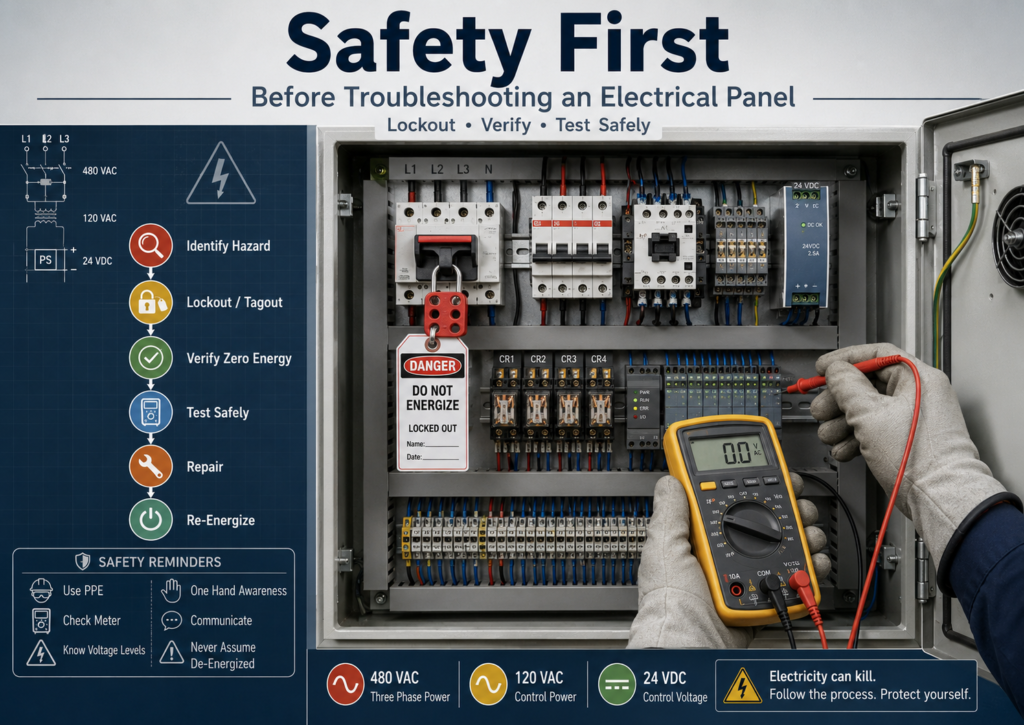
What Every Technician Should Check Before Testing Live Circuits
Troubleshooting an electrical control panel can be one of the most important skills for an automation or maintenance technician. But before using a multimeter, checking a fuse, resetting an overload, or testing a PLC output, safety must come first.
Electrical troubleshooting is not only about finding the fault. It is also about protecting yourself, protecting others, and preventing additional damage to the equipment.
A control panel may contain different energy levels, such as 24 VDC control power, 120 VAC control circuits, 240 VAC or 480 VAC motor circuits, stored energy, capacitors, transformers, power supplies, contactors, relays, and PLC I/O wiring.
That means every troubleshooting task must begin with one question:
Can I perform this test safely?Technicians must use proper safety precautions when working with electrical circuits and that repairs should only be performed after the power source has been turned off and locked out.
1. Never Assume the Panel Is Safe
One of the most dangerous assumptions in electrical troubleshooting is believing that a panel is safe just because:
The machine is stopped.
The HMI is off.
The motor is not running.
The disconnect is open.
The PLC output is off.
The indicator light is off.
None of these conditions automatically prove that the panel is de-energized.
A panel can still have:
- Incoming line voltage
- Control transformer voltage
- 24 VDC power supply output
- Backfed voltage from another circuit
- Stored energy in capacitors
- UPS or battery backup power
- External field wiring voltage
- Multiple power sources
A stopped machine is not the same as a safe machine.
Before touching conductors or components, always verify the electrical condition of the panel using approved procedures and proper test equipment.
2. Understand What Type of Energy Is Inside the Panel
A control panel may contain more than one voltage level. This is common in industrial automation.
Example:
480 VAC  → Motor power
120 VAC  → Control circuit
24 VDC   → PLC inputs, sensors, solenoids
Ethernet → Communication network
Air      → Pneumatic actuators
This is why opening a panel requires awareness. Even if one part of the circuit is off, another part may still be energized.
Before troubleshooting, identify:
| Area | What to Check |
|---|---|
| Main power | Incoming voltage, disconnect, fuses, breakers |
| Control power | Transformer, power supply, 120 VAC or 24 VDC |
| PLC power | Processor status, I/O module power, field power |
| Motor power | Contactors, overloads, VFDs, motor leads |
| Field wiring | Sensors, solenoids, junction boxes, external devices |
| Stored energy | VFD DC bus, capacitors, UPS, pneumatic pressure |
A professional technician does not treat the entire panel as one simple circuit. A professional technician identifies each energy source.
3. Use Lockout/Tagout Before Repairing
Troubleshooting sometimes requires live testing. But repairing, replacing, tightening, or disconnecting components should normally be done with the power off and properly locked out.
The manual clearly states that when the problem is determined, the power feeding the control system must be turned off and a Lock-Out device must be installed before making repairs.
A safe repair process should look like this:
Identify the problem.
Stop the equipment.
Notify affected personnel.
Turn off the energy source.
Apply Lockout/Tagout.
Verify zero energy.
Perform the repair.
Remove tools and restore guards.
Remove LOTO according to procedure.
Test the machine safely.
The key point is this:
Live troubleshooting may be necessary in some cases, but live repair is not normal work.
4. Verify Before Touching
The phrase “test before touch” is extremely important.
Before touching any conductor, terminal, or component, verify that voltage is not present.
A common safety method is:
Live → Dead → LiveMeaning:
- Test your meter on a known live source.
- Test the circuit you believe is de-energized.
- Test your meter again on a known live source.
This helps confirm that the meter was working before and after the test.
Do not trust a zero reading if:
The meter is on the wrong function.
The test leads are in the wrong ports.
The fuse inside the meter is blown.
The probes are not making contact.
The circuit reference point is incorrect.
A zero reading only means something if the test was performed correctly.
5. Check the Multimeter Before Using It
A multimeter is one of the most important tools for electrical troubleshooting, but it can also be dangerous if used incorrectly.
Before testing, confirm:
Correct function: AC volts, DC volts, resistance, continuity
Correct range: suitable for expected voltage
Correct leads: good insulation, no exposed metal damage
Correct ports: COM and V/Ω for voltage
Correct meter rating: CAT rating appropriate for the panel
The manual gives a direct warning: always make sure the multimeter is set to the proper range and function before troubleshooting.
This matters because selecting the wrong meter function can create a short circuit or damage the meter.
For example:
| Wrong Action | Possible Result |
|---|---|
| Measuring voltage while meter is in amps mode | Short circuit through meter |
| Measuring live voltage in resistance mode | Meter damage or shock hazard |
| Leads plugged into current port by mistake | Dangerous short path |
| Damaged probe insulation | Shock or arc risk |
| Wrong voltage category meter | Meter failure during transient event |
Before every measurement, slow down and check the meter.
6. Know When to Use Voltage, Continuity, or Resistance
Not every test is done with the panel energized.
A common mistake is using continuity or ohms on an energized circuit. This is unsafe and can damage the meter.
Use this simple rule:
| Test Type | Circuit Condition |
|---|---|
| Voltage test | Circuit energized |
| Continuity test | Circuit de-energized |
| Resistance test | Circuit de-energized |
| Fuse resistance check | Fuse isolated/de-energized |
| Coil resistance check | Coil isolated/de-energized |
| Wire continuity check | Wire isolated/de-energized |
Voltage testing tells you if electrical energy is present.
Continuity and resistance testing should only be performed after verifying the circuit is de-energized.
7. Be Careful Around 24 VDC Too
Many technicians respect 480 VAC and 120 VAC, but sometimes they get careless with 24 VDC.
That is a mistake.
Even though 24 VDC is lower voltage, shorting 24 VDC can still cause:
Blown fuses
Damaged PLC output cards
Damaged sensors
Power supply shutdown
Machine faults
Burned wires
Unexpected actuator movement
In automation panels, 24 VDC often feeds PLC inputs, outputs, sensors, solenoids, relays, and safety circuits. A small mistake can shut down a machine or damage expensive components.
Treat 24 VDC with discipline.
8. Watch for Stored Energy
Some components can remain dangerous even after power is removed.
Examples:
VFDs
Servo drives
DC bus capacitors
Power supplies
UPS systems
Pneumatic actuators
Hydraulic accumulators
Spring-loaded mechanisms
A VFD may still have DC bus voltage after the main disconnect is off. Always follow the manufacturer’s discharge time and verify absence of voltage before touching terminals.
Also remember that electrical troubleshooting is not only about electricity. A machine can move due to air pressure, gravity, springs, or stored mechanical energy.
Before working inside a panel or machine area, think about all energy sources, not only voltage.
9. Keep One Hand Rule Awareness
When measuring live circuits, technicians are often taught to avoid creating a path through the body.
A practical safety habit is to keep one hand away from the panel when possible and avoid leaning against grounded metal surfaces.
This does not replace PPE, training, or electrical safety procedures, but it helps reduce risk.
Also avoid wearing conductive jewelry such as:
Rings
Watches
Bracelets
Neck chains
Metal tools in pockets
A small metal object can create a serious short circuit inside a panel.
10. Do Not Bypass Safety Devices
During troubleshooting, never permanently bypass or defeat safety devices.
Examples:
E-Stops
Safety relays
Interlock switches
Guard switches
Light curtains
Door switches
Overloads
Fuses
Circuit breakers
Temporary testing should only be done under approved procedures, by qualified personnel, and with full awareness of the risk.
A machine that runs with a bypassed safety circuit is not repaired. It is unsafe.
If a safety device is suspected of causing a stop condition, troubleshoot it correctly. Do not simply jump it out and walk away.
11. Communicate Before Testing
Before energizing, jogging, resetting, or testing a machine, communicate with nearby personnel.
A good habit:
Stop.
Look around.
Announce the action.
Verify nobody is in the danger zone.
Then test.
Examples:
“Clear from the conveyor?”
“I am going to reset the fault.”
“I am going to jog the motor.”
“I am restoring control power.”
“I am about to test the output.”
Many accidents happen because one person is testing while another person is working near the machine.
Good troubleshooting includes communication.
12. Safety Checklist Before Troubleshooting
Before beginning electrical panel troubleshooting, use a simple checklist:
[ ] Understand the reported symptom.
[ ] Identify voltage levels in the panel.
[ ] Review the electrical diagram if available.
[ ] Confirm PPE requirements.
[ ] Inspect the multimeter and test leads.
[ ] Set the meter to the correct function.
[ ] Identify safe reference points.
[ ] Keep hands and tools clear of energized terminals.
[ ] Use LOTO before repair or replacement.
[ ] Verify zero energy before touching conductors.
[ ] Communicate before energizing or testing motion.
[ ] Document findings and corrective action.
This checklist may look simple, but it builds professional discipline.
13. Final Thoughts
Electrical panel troubleshooting starts with safety.
Before using a multimeter, replacing a fuse, resetting an overload, or testing a PLC output, a technician must understand the energy inside the panel and decide how to work safely.
A good technician is not just fast.
A good technician is controlled, methodical, and aware of risk.
The correct mindset is:
Identify the hazard.
Control the energy.
Use the right test method.
Prove the fault.
Repair safely.
Verify operation.
The goal is not only to get the machine running again. The goal is to get it running again without injury, without damage, and without creating a new problem.