Sensor Debounce in Industrial Control Systems
Sensor Debounce in Industrial Control Systems
When to Use It, Why It Matters, and How to Apply It
What is Sensor Debounce?
Sensor debounce is a control strategy used to filter out rapid, unintended ON/OFF transitions (“noise” or “chatter”) from a signal before it is accepted as valid by the control system. In PLC-based automation, debounce is typically implemented using timers such as TON (On-Delay) and TOF (Off-Delay).
Ladder Logic Templates (Input & Output Debounce)
Below are practical, ready-to-use patterns aligned with real industrial PLC programming (Allen-Bradley / Studio 5000 style).
1. INPUT DEBOUNCE TEMPLATE (Recommended Standard)
Purpose
Clean noisy sensor signals before they enter your logic
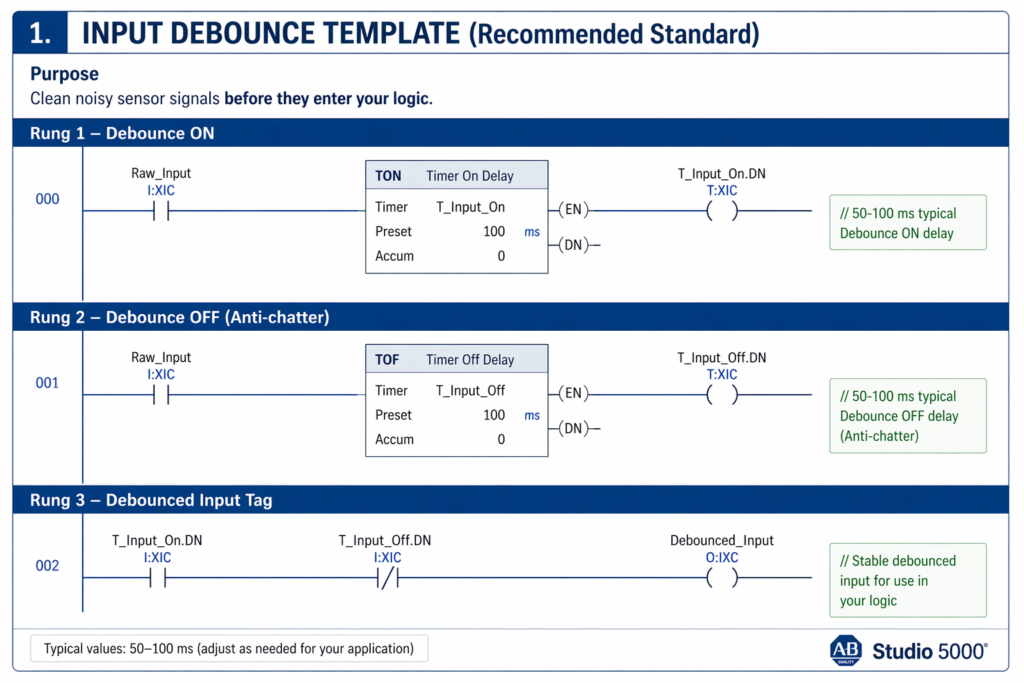
Result
Debounced_Inputis now stable- Use this tag everywhere in your program instead of the raw input
2. OUTPUT DEBOUNCE TEMPLATE (Best Practice)
Purpose
Prevent output devices (e.g., solenoid valves) from chattering
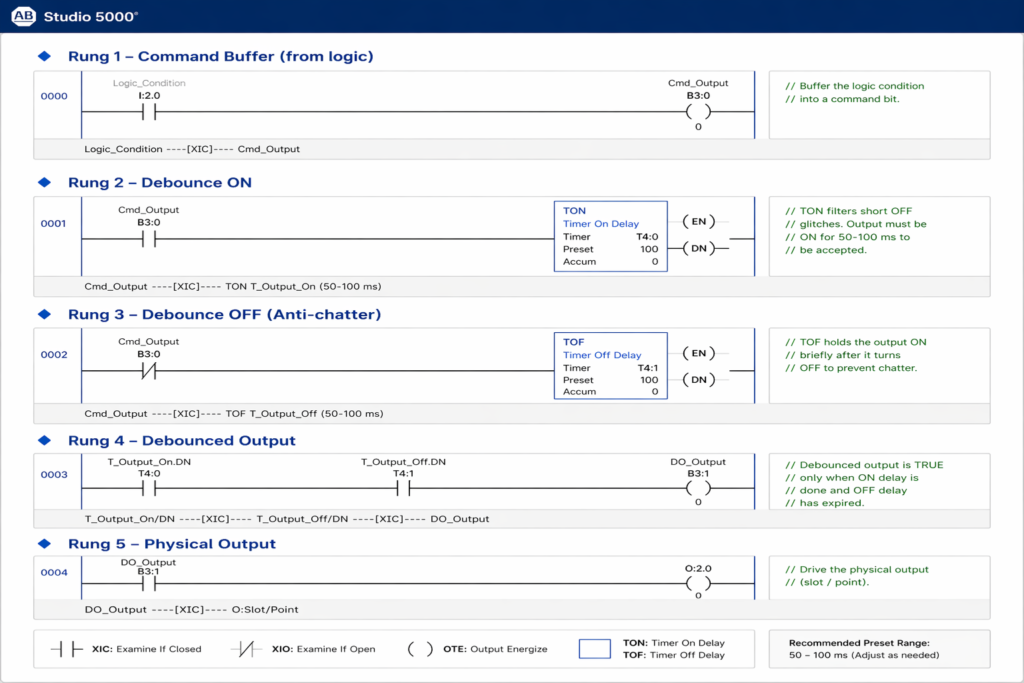
Result
- Output turns ON only after validation
- Output turns OFF only after stable OFF condition
- Eliminates valve chatter and false triggering
Key Design Concept
Final Output = (Valid ON Signal) AND (Valid OFF Condition)
Naming Convention (Recommended)
| Type | Example Name |
|---|---|
| Raw Input | I_Start_PB |
| Debounced Input | I_Start_PB_DB |
| Command Output | Cmd_SolenoidValve |
| Debounced Output | DO_SolenoidValve_DB |
| Timers | T_SV_On, T_SV_Off |
Common Mistakes to Avoid
- ❌ Driving outputs directly from raw inputs
- ❌ Using only TON (no OFF filtering)
- ❌ Excessive delay (sluggish system response)
- ❌ Not buffering outputs before physical I/O
Pro Tip (Real-World Systems)
In advanced systems, this pattern is often wrapped into:
- AOIs (Add-On Instructions) in Studio 5000
- Reusable function blocks
- Standardized control modules
This ensures consistency across the entire plant.
Final Thoughts
A proper debounce implementation—on both inputs and outputs—is essential for building robust, reliable, and maintainable control systems. These templates provide a proven structure used in real industrial environments and can be easily adapted to any PLC platform.