Industrial Cybersecurity in Modern Automation Systems
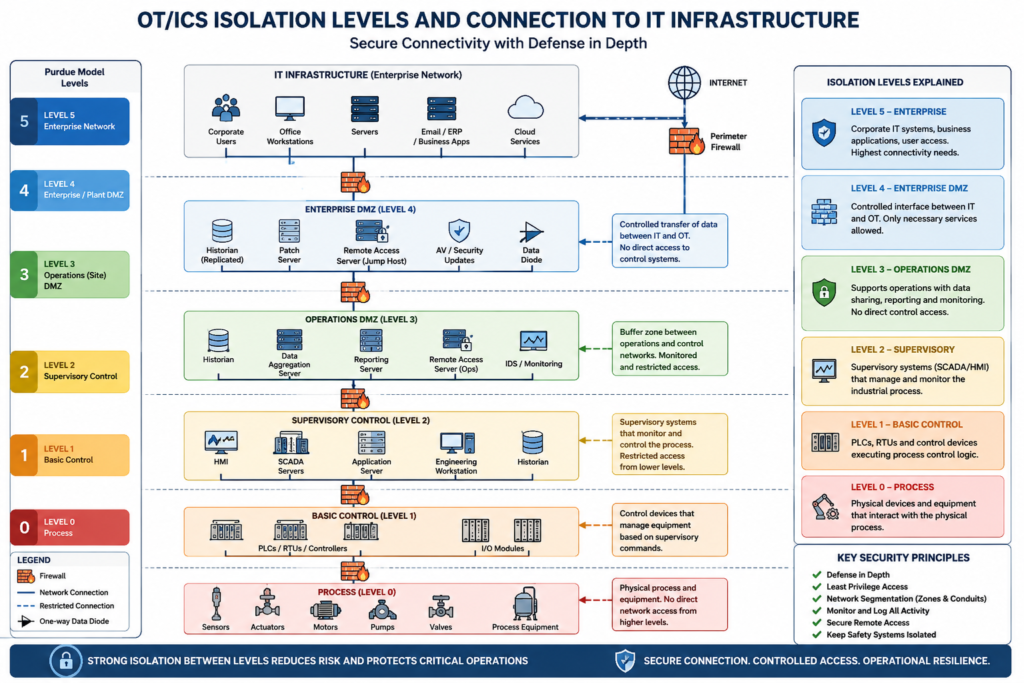
Building Secure OT Networks with IEC 62443 Principles
Industrial cybersecurity has become one of the most critical topics in modern automation. As Operational Technology (OT) systems continue integrating with enterprise IT networks, cloud services, remote access solutions, and Industrial IoT devices, industrial environments are increasingly exposed to cyber threats that were once limited mostly to corporate IT systems.
Unlike traditional IT environments, cybersecurity incidents in industrial systems can directly affect:
- Personnel safety
- Equipment reliability
- Production continuity
- Product quality
- Environmental protection
- Business operations
This is why industrial cybersecurity requires a completely different mindset from traditional IT security.
IT vs OT Cybersecurity
One of the most important concepts in industrial cybersecurity is understanding the difference between IT and OT environments.
Traditional IT Security Focus
IT systems primarily focus on:
- Data confidentiality
- User privacy
- Email and cloud security
- Business applications
- Financial information
In IT environments, rebooting a server or temporarily shutting down a system may be acceptable.
OT Security Focus
Operational Technology environments prioritize:
- Safety
- Availability
- Reliability
- Process continuity
In OT environments:
- Rebooting a PLC may stop production
- Disconnecting a network switch may halt an entire process line
- A cybersecurity event may create unsafe operating conditions
This is why industrial environments require specialized standards such as IEC 62443.
The CIA Model vs OT Priorities
Traditional IT Security (CIA)
- Confidentiality
- Integrity
- Availability
Industrial OT Priorities
- Safety
- Availability
- Reliability
- Integrity
- Confidentiality
In industrial environments, keeping systems running safely is usually more important than confidentiality alone.
What is OT Cybersecurity?
Operational Technology (OT) cybersecurity focuses on protecting Industrial Automation and Control Systems (IACS), including:
- PLCs (Programmable Logic Controllers)
- HMIs (Human Machine Interfaces)
- SCADA systems
- Engineering Workstations
- Industrial Networks
- Safety Instrumented Systems (SIS)
- Industrial servers and historians
- Field devices such as sensors, valves, drives, and actuators
These systems are responsible for controlling real-world industrial processes in:
- Manufacturing
- Food & Beverage
- Pharmaceutical
- Water Treatment
- Oil & Gas
- Power Generation
- Packaging and Material Handling
A successful cyberattack in these environments can stop production, damage equipment, or create hazardous conditions.
IEC 62443 – The Industrial Cybersecurity Standard
One of the most important standards in industrial cybersecurity is:
IEC 62443
IEC 62443 is an international cybersecurity standard specifically developed for Industrial Automation and Control Systems (IACS).
Its purpose is to:
- Reduce cybersecurity risk
- Improve system resilience
- Define security responsibilities
- Establish secure industrial architectures
- Protect critical infrastructure
Unlike traditional IT standards, IEC 62443 was designed specifically for industrial environments where:
- Availability is critical
- Downtime is expensive
- Systems often run continuously for years
- Safety is directly connected to operations
- Legacy equipment is common
The Purdue Model
A common architecture model used in OT cybersecurity is the Purdue Model.
The Purdue Model separates industrial systems into logical layers:
| Level | Description |
|---|---|
| Level 0 | Physical Process (sensors, motors, valves) |
| Level 1 | Basic Control (PLCs, RTUs, I/O) |
| Level 2 | Supervisory Control (HMI, SCADA) |
| Level 3 | Site Operations |
| Level 4 | Enterprise IT |
| Level 5 | Cloud / Internet Services |
The purpose of this model is to create proper separation between industrial control systems and enterprise IT infrastructure.
Zones and Conduits (IEC 62443)
One of the most important IEC 62443 concepts is:
Zones
Groups of assets with similar security requirements.
Examples:
- PLC network
- HMI network
- Safety network
- Enterprise IT network
Conduits
Controlled communication paths between zones.
Examples:
- Firewalls
- Industrial routers
- VLANs
- Secure VPN connections
This architecture helps reduce lateral movement during a cyberattack.
Why Network Segmentation Matters
Without segmentation, an attacker who compromises a business laptop may eventually reach:
- HMIs
- SCADA servers
- PLC networks
- Engineering workstations
- Safety systems
Proper segmentation limits the spread of cyber incidents and protects critical industrial assets.
Flat networks are one of the most dangerous conditions in industrial environments.
Defense in Depth
Industrial cybersecurity should never rely on a single protection layer.
Instead, secure OT environments use multiple layers of defense:
| Security Layer | Example |
|---|---|
| Physical Security | Locked cabinets and control rooms |
| Network Security | Firewalls, VLANs, NAT |
| Endpoint Security | Antivirus, application whitelisting |
| Access Control | MFA, RBAC |
| Monitoring | IDS, SIEM |
| Recovery | Backups and disaster recovery |
If one layer fails, another layer still protects the system.
What is an OT DMZ?
A DMZ (Demilitarized Zone) is a secure buffer network between IT and OT systems.
Its purpose is to:
- Prevent direct access from IT networks to PLC networks
- Control data exchange
- Isolate critical industrial systems
Typical systems inside a DMZ include:
- Historian replication servers
- Patch management servers
- Jump servers
- Antivirus update servers
- Remote access gateways
A properly designed DMZ is one of the most important protections in industrial cybersecurity.
Remote Access Security
Remote access is one of the largest attack surfaces in industrial environments.
Modern facilities often require:
- Vendor support
- Remote troubleshooting
- Remote engineering access
- Remote monitoring
However, insecure remote access can expose critical systems directly to attackers.
Recommended Best Practices
- Use VPNs with MFA
- Use jump servers
- Log all remote sessions
- Restrict access by role
- Disable inactive accounts
- Time-limit vendor access
- Never expose PLCs directly to the internet
Security Levels (SL)
IEC 62443 defines Security Levels based on threat sophistication.
| Security Level | Protection Against |
|---|---|
| SL1 | Basic mistakes and simple malware |
| SL2 | Common cyber threats and ransomware |
| SL3 | Sophisticated attackers |
| SL4 | Nation-state and advanced persistent threats |
These levels help organizations determine how much protection is required based on operational risk.
The 7 Foundational Requirements (FR)
IEC 62443 defines seven foundational requirements for industrial cybersecurity.
FR1 – Identification and Authentication Control
Verify users and devices before granting access.
FR2 – Use Control
Restrict actions based on assigned privileges.
FR3 – System Integrity
Protect systems from unauthorized modifications.
FR4 – Data Confidentiality
Protect sensitive industrial information.
FR5 – Restricted Data Flow
Limit communication between systems.
FR6 – Timely Response to Events
Detect and respond quickly to incidents.
FR7 – Resource Availability
Ensure systems remain operational even during cyber events.
OT Asset Inventory
You cannot protect assets you do not know exist.
A proper OT inventory should include:
- PLCs
- HMIs
- Managed switches
- VFDs
- Industrial PCs
- Safety controllers
- Firmware versions
- IP addresses
- Network topology
Asset visibility is the foundation of industrial cybersecurity.
Cybersecurity and Functional Safety
In industrial environments, cybersecurity failures can become safety incidents.
A compromised control system could:
- Disable alarms
- Manipulate process values
- Stop safety functions
- Cause unexpected machine movement
This is why Safety Instrumented Systems (SIS) are often physically separated from standard control systems.
Best practices include:
- Dedicated infrastructure
- No shared switches
- Restricted remote access
- One-way communication where possible
Common OT Security Mistakes
Never Do This
❌ Direct internet access to PLCs
❌ Flat plant-wide networks
❌ Shared administrator accounts
❌ Disabled firewalls “for convenience”
❌ Uncontrolled USB devices
❌ Shared IT/OT credentials
❌ No backups of PLC or HMI programs
❌ No monitoring of vendor remote access
These mistakes significantly increase cybersecurity risk.
Real Industrial Technologies Used in OT Security
Modern industrial cybersecurity often includes:
- Stratix managed switches
- Industrial firewalls
- VLAN segmentation
- NAT configurations
- SCADA security hardening
- Historian replication
- FactoryTalk systems
- Studio 5000 engineering workstations
- Secure remote access gateways
- EtherNet/IP segmentation
Cybersecurity is no longer separate from automation engineering — both now work together.
Why Industrial Cybersecurity Matters
A successful cyberattack can result in:
- Production downtime
- Equipment damage
- Environmental incidents
- Safety hazards
- Financial losses
- Regulatory consequences
- Loss of customer trust
Industrial cybersecurity is ultimately about:
- Reliability
- Availability
- Safety
- Business continuity
Final Thoughts
Industrial cybersecurity is no longer optional in modern automation environments. As industrial systems continue integrating with enterprise networks and remote technologies, the importance of secure architectures and risk-based security strategies continues to grow.
Standards like IEC 62443 provide a practical framework for protecting industrial systems through defense-in-depth, network segmentation, access control, monitoring, and secure operational practices.
Cybersecurity in OT is not only about protecting data — it is about protecting people, processes, equipment, and production.
For automation professionals, understanding these concepts is becoming just as important as understanding PLC programming, industrial networking, and troubleshooting.